Pavillon d'Artois, Historical monument in Vaux-sur-Seine, France.
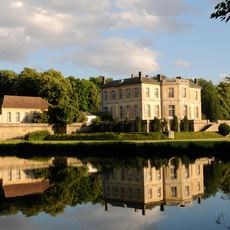
The Pavillon d'Artois stands at no. 187, rue du Général-de-Gaulle in Vaux-sur-Seine, not on the Grande-Rue. The present hôtel particulier, built 1726–1728 for Jacques Fayolle, forms a U-shaped main block on two levels above a basement, entered on the north through a wide rotunda ringed by twelve Doric columns. The south facade opens onto the gardens through five bays of windows, the three central ones projecting with a portico at garden level and a balcony above, their upper windows framed by bas-reliefs copied from Pompeii originals.
A 17th-century building with a keep, owned by Louis Hébert de Saint-Gervais from 1684, stood here; he sold it in 1699 to the court painter Hyacinthe Rigaud, who lived there about fifteen years. Jacques de Fayolle had it demolished and built the present structure between 1726 and 1728, possibly to designs by Germain Boffrand or Robert de Cotte. In 1775 the Count of Artois, the future Charles X, bought it and had it remodelled in neo-Palladian style, perhaps by François-Joseph Bélanger.
The name comes from Charles-Philippe de France, comte d'Artois and future Charles X, who bought the house in 1775. Since 2021 the owners Pierre and Marie-Alyette Fournel hold cultural events there. The entrance gate at no. 187 carries a small blue plaque reading "173".
The property is privately owned and typically not open to visitors. During Heritage Days in September, interested people can join guided tours when owners allow access to the rooms and garden for a limited time.
The garden's grotto is attributed to Richard Mique, Marie-Antoinette's personal architect. The estate also keeps its own landing stage on the Seine, at the edge of the four-hectare park.
The community of curious travelers
AroundUs brings together thousands of curated places, local tips, and hidden gems, enriched daily by 92,955 contributors worldwide.