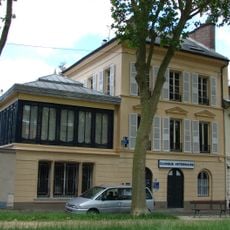
Pavillon Saint-Vigor, Historical pavilion in Viroflay, France.
Pavillon Saint-Vigor is a classical residential building from the 18th century with three connected sections, the central one rising higher than the flanking wings. Its facade displays Doric columns and peaked windows facing the garden side.
Built in 1770 by a pupil of the architect Gabriel, the pavilion belonged to the family of Marie-Madeleine Mercier (née Bocquet), former wet nurse of Louis XV. The king ennobled her descendants, who took the name "de Saint-Vigor" and settled in Viroflay. It was listed as a monument historique in 1945 and 1946, then stood almost abandoned for about thirty years until new owners restored it in 2004.
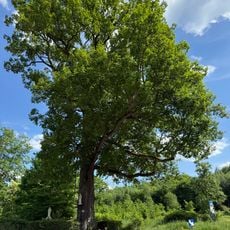
The estate takes its name from Marie-Madeleine Mercier, née Bocquet, Louis XV's former wet nurse; the king ennobled her descendants, who became "de Saint-Vigor" and settled in Viroflay. In 1794 two poplars, "arbres de la liberté", were planted on the former half-moon where carriages once turned.
The pavilion stands in Viroflay, in the Yvelines; the garden front is reached from the street side, where the stone wall and double gate frame the entrance. The former half-moon forecourt that let carriages turn has gone, and part of the surrounding park is now the Clos Saint-Vigor residence, so the house is seen from outside rather than toured. It is a private dwelling, inscribed as a monument historique since 1945 and 1946.
The salon's parquet floor was burned by German troops occupying the property during World War II; the present floor comes from the Hall of Mirrors at the Château de Versailles. The two tall poplars planted in 1794 as liberty trees stood where a half-moon turning area once let carriages manoeuvre.
The community of curious travelers
AroundUs brings together thousands of curated places, local tips, and hidden gems, enriched daily by 93,756 contributors worldwide.