Château de Dun-sur-Auron, Medieval castle in Dun-sur-Auron, France.
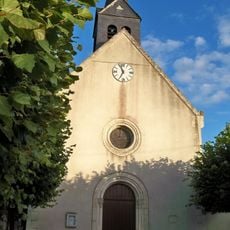
The Château de Dun-sur-Auron, also called La Salle-le-Roi, stands in the town centre. Its surviving element is the Porte de l'Horloge, a square stone gate with two corner turrets, often mistaken for a keep. A round clock face sits above the arched passage, and the tower rises into an octagonal section topped by a steep slate roof with dormer windows.
King Philip II Augustus ordered the complete reconstruction of the castle in 1202 after acquiring the viscounty of Dun, adding new walls and towers to strengthen it as a royal fortress. Over later centuries, it transitioned from royal residence into a prison and courthouse before becoming a public museum.
The name Dun derives from the Gallo-Roman Dunum, meaning fortified enclosure, attested as Dunesi in 880 and Duno in 1095. The gate, often mistaken for a keep, is called porte de l'Horloge and served as belfry after the 14th century. Its square plan with two corner turrets follows the model of Bourges keep, built around 1190.
The medieval structure stands in the heart of the town centre, spread across place de la Halle, place du Châtelet and boulevard du Midi, so it is reached on foot rather than on a hill. Its interior was later modified to house a museum. Look for the arched passage at the base of the tower, which serves as the entrance.
The Porte de l'Horloge, often mistaken for a keep, was the first structure built on the site in 1202. It later lost its role as a city gate but kept its function as a belfry. The tower's square plan with two corner turrets follows the model of the keep of Bourges, built around 1190.
The community of curious travelers
AroundUs brings together thousands of curated places, local tips, and hidden gems, enriched daily by 92,781 contributors worldwide.