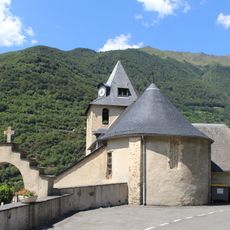
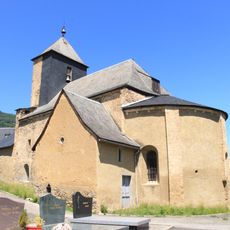
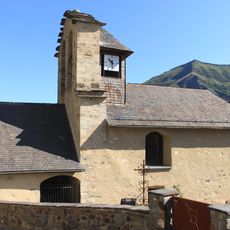
Château de Sainte-Marie, ruined castle in Esterre in the Hautes-Pyrénées département of France
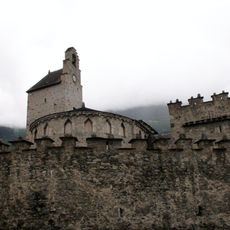
The Château de Sainte-Marie is a ruined medieval castle on a rocky outcrop at 630 metres in Esterre. Only a round tower and a square keep remain, with a narrow enceinte. The square northern tower has arrowslits and crenellations at the top; the round keep has a dark rectangular window and a small opening below it. A dark arched doorway sits at the base of the square tower.
Built in the 10th century by Centule III, Count of Bigorre, on a rocky spur above the valley, the castle may stand on an older Arab-occupied site. The English held it until 1404, when Jean II de Bourbon, Count of Clermont, with valley inhabitants led by Aougé de Coufitte, drove them out. It was then gradually abandoned; the ruins were listed as monuments historiques in 1930.
The name comes from the priory of Sainte-Marie that once stood in front of the castle; its chapel was already in ruins around 1800 and was then destroyed. The castle ruins themselves were inscribed on the list of monuments historiques in 1930. Arsène Lupin, the fictional gentleman thief, is said to have escaped from here through a tunnel, and many other legends are attached to the site.
The ruins stand on a rocky outcrop at 630 m, above Esterre, Esquièze-Sère and Luz-Saint-Sauveur; the climb is on foot. Access was long uncertain: a 30-year lease held by the syndical commission expired in 2018, and the commune of Esterre only bought the castle in June 2019 for a symbolic euro. Check locally before setting out.
Arsène Lupin, Maurice Leblanc's fictional gentleman thief, is said to have escaped from the castle through a tunnel, one of several legends attached to the ruins. The tale is not medieval: it comes from the Lupin stories, and locals still tell it alongside older ones.
The community of curious travelers
AroundUs brings together thousands of curated places, local tips, and hidden gems, enriched daily by 93,237 contributors worldwide.