Napoléon bridge, Stone bridge in Luz-Saint-Sauveur, France
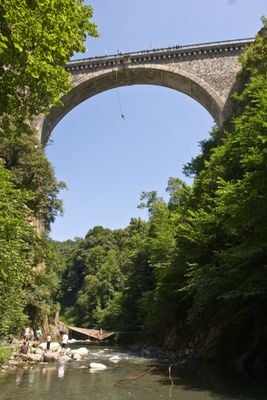
Napoléon bridge is a single stone arch over the Gave de Gavarnie near Luz-Saint-Sauveur. Its deck runs 69 metres long, 65 metres above the river, and the supporting arch has a 42-metre diameter, springing from the sheer rock at 40 metres. The roadway is 4 metres wide, flanked by 85-centimetre cantilevered sidewalks on stone consoles, with a 24-tonne cast-iron balustrade above a projecting cornice.
French Emperor Napoleon III commissioned engineer Bruniquel to build this bridge between 1859 and 1863. The construction was part of a broader plan to develop the mountain region and improve its accessibility.
The bridge carries Napoleon's name and displays French 19th-century history through its column topped with an eagle. Visitors can observe this symbolism while crossing and examining the monument's architectural details.
The deck is 4 m wide with 85 cm cantilevered sidewalks on stone consoles, so crossing on foot means sharing a narrow roadway. The arch springs 40 m above the Gave and the keystone sits at 65 m, with the roadway 3 m higher. The Lourdes stone column with its eagle stands at the east end, on the right bank.
Two narrow vaults were built between the main arch and the roadway to lighten the masonry, leaving the underside of the deck hollow. Bats have colonised these two galleries inside the bridge. The 24-tonne cast-iron balustrade rests on stone consoles.
The community of curious travelers
AroundUs brings together thousands of curated places, local tips, and hidden gems, enriched daily by 92,931 contributors worldwide.