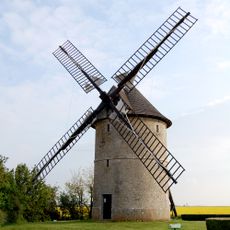
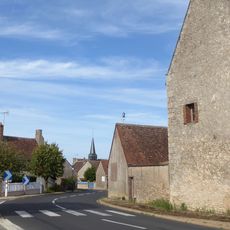
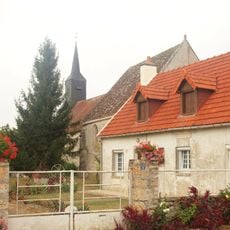
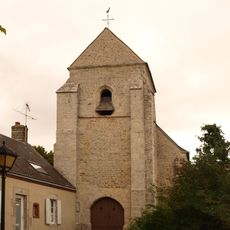
Voie de Jules César, Roman road in Beauce la Romaine, France
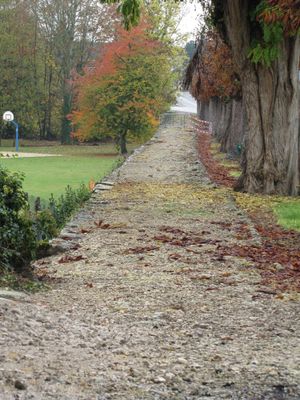
The Voie de Jules César is a Roman road stretching between two major urban centers and passing through several historical regions. The pavement in various sections still displays characteristic Roman construction techniques with carefully arranged stones and gravel materials.
The route may have begun as one or more Gaulish paths straightened in antiquity; it was certainly used in Roman times and through the Middle Ages, though it was not laid out by Caesar's administration. Under the Roman Empire it carried wood from the forest of Marchenoir to supply the Beauce, a trade that lasted until the 19th century. Only the sections crossing Beauce la Romaine were listed as a monument historique in 1978.
The name Jules César is a later attribution: ancient works were routinely credited to Rome's most famous figure, and about forty French roads carry this name. Medieval texts call it Blesencis calceatus callis, the paved road of Blois, in the cartulary of Saint-Laumer Abbey, and Cassini's map labels it chemin de Blois. Place-names along the route, such as le Chemin Chausset at Vievy-le-Rayé or la Chaussay at Averdon, recall its paved surface.
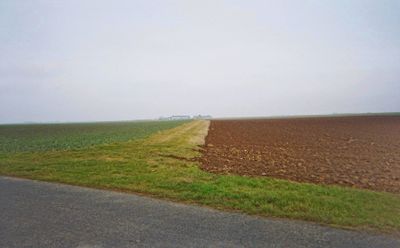
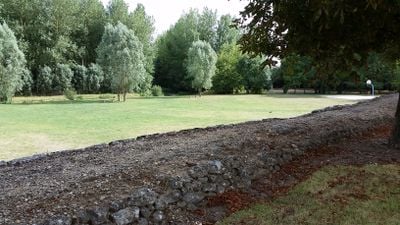
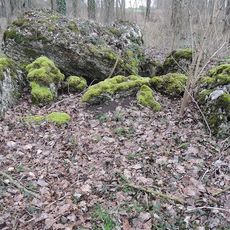
The original gravel-and-stone surface is still visible south of the village of Verdes, where the road crosses the Aigre as a dam-like embankment. Elsewhere the route survives as field boundaries, dirt tracks and paved roads: the D 935 from Chartres to Dammarie, the D 127 towards Nottonville, then the D 110 and D 924 to Blois. The crossing of the Conie valley at Varize is uncertain, with a ford reported there.
The road was built so high that it functioned like a dam and altered the water flow of a nearby river. This raised construction method with stone and gravel shows how Roman engineers reshaped the landscape to build their roads.
The community of curious travelers
AroundUs brings together thousands of curated places, local tips, and hidden gems, enriched daily by 94,217 contributors worldwide.