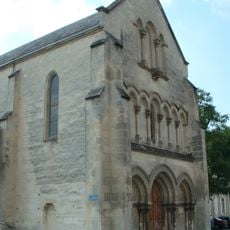
Château de Vervant, Historical castle in Vervant, France.
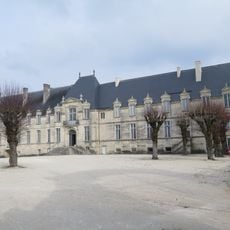
The Château de Vervant is a pale stone castle standing behind a stone balustrade topped with green urns of red flowers. It has two steep dark grey hipped roofs, the right one pyramidal and taller, the left one wider and slightly lower with a small chimney. The left façade shows tall windows, flat pilasters and statues in niches below the roofline, and a large dark green tree covers much of the right side.
Vervant is mentioned from 1338, when the land belonged to Ybles de La Rochandry and depended on the château d'Aulnay. In 1606 Jean Boisseau, sieur de Pouzou, acquired it and received Louis XIII there in May 1621. Louis de Crès went into debt restoring the château before ceding it in 1782; in 1792 it was bought by Jean Martell, son of the Cognac merchant house's founder.
The castle's name comes from the Vervant land, mentioned in 1338 as a dependency of the château d'Aulnay. In May 1621 Jean Boisseau, sieur de Pouzou, received King Louis XIII there during his passage through Saintonge. The façade statues in niches and the tall windows visible from the balustrade date from later campaigns, including the restoration and embellishment works of Lodoïs de Senigon de Rousset de Roumefort du Cluzeau after 1870.
The château stands in the commune of Vervant, in Charente-Maritime, at coordinates 45.97630, -0.45360. Its façades and roofs were listed as monuments historiques by decree of 22 August 1949, so the building is seen from the outside; the grounds are private property and not open as a visitor attraction.
The castle was requisitioned by German forces from July 1940 to August 1944, while its owner Roger de Senigon de Rousset de Roumefort du Cluzeau, director general of the Crédit foncier Franco-Canadien, was based in Montreal. After this episode the building was restored using war damages under the architect Jean Daugrois.
The community of curious travelers
AroundUs brings together thousands of curated places, local tips, and hidden gems, enriched daily by 94,700 contributors worldwide.