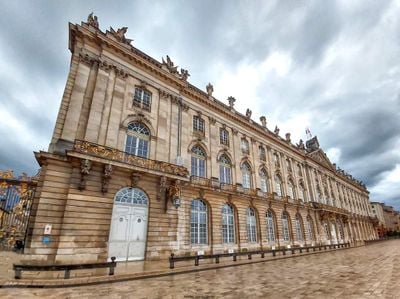
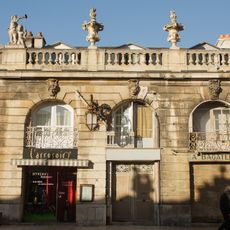
Hôtel de ville de Nancy, City hall in Place Stanislas, France
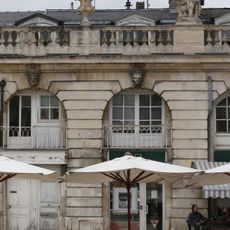
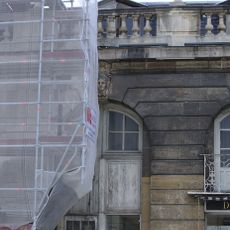
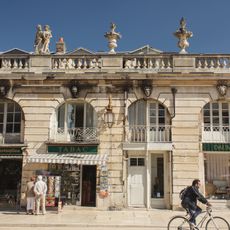
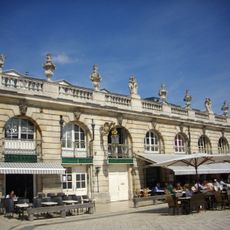
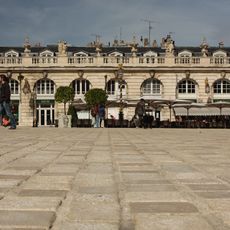
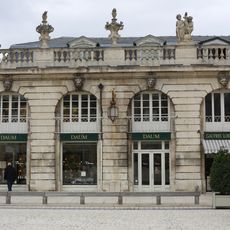
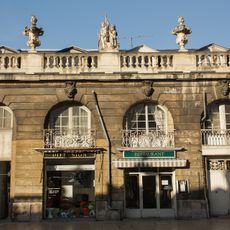
The Hôtel de Ville de Nancy closes the south side of Place Stanislas with a 98-metre ashlar facade of 19 bays, its three projecting sections at the centre and ends breaking the line. The rusticated ground floor carries three round-headed doorways; above, Corinthian pilasters rise to a modillioned pediment with the Stanislas coat of arms, a clock and statues of Justice and Prudence. A balustraded parapet with small figures runs along the roofline.
Stanisław Leszczyński, Duke of Lorraine after abdicating the Polish throne, commissioned the town hall to replace the Hôtel de Gerbéviller and the Hôtel de Juvrécourt. Construction began in March 1752 to designs by Emmanuel Héré de Corny, and Leszczyński opened the building on 26 November 1755. Revolutionaries ransacked many rooms in 1792, and the rear wing by Prosper Morey was added in 1862.
The building has served as Nancy's town hall since its opening by Stanisław Leszczyński on 26 November 1755. In the Salon Carré, four wall paintings by Jean Girardet show Apollo for the society of sciences and letters, Jupiter for justice, Aesculapius for the medical college and Mercury for support of merchants; the ceiling shows Stanislas driving Apollo's chariot.
The hall sits directly on Place Stanislas and is easily reached on foot while exploring the old town. The exterior is fully visible from the square, though note that this remains an active administrative building.
Inside, one room displays elaborate stucco work and painted ceiling frescoes in classical style. These decorations were created to honor a ruler who shaped the city's transformation.
The community of curious travelers
AroundUs brings together thousands of curated places, local tips, and hidden gems, enriched daily by 92,853 contributors worldwide.