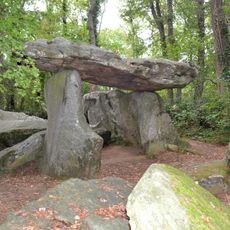
Pierre du Diable, Prehistoric menhir in La Garnache, France
The Pierre du Diable, also called the menhir de la Grande-Émonnière, is a square slab of stone 2.20 m high and 2.30 m wide, set 0.20 m into the ground and weighing about 5 tonnes. Its weathered face is grey-green with light-green lichen, pitted with hollows and vertical crevices, and thin vines climb its right side.
The menhir was already mentioned in 1864 by Abbot Baudry and was rediscovered in 1907. Having fallen, it was re-erected in September 1933 by Marcel Baudouin (1860–1941). It was classified as a monument historique by decree of 24 September 1934.
Local stories describe a nobleman who challenged the devil to build a castle before dawn, and according to folklore, the devil dropped this final stone at this spot. Tales like these helped people long ago make sense of why a large standing stone existed in their landscape.
The menhir stands southwest of La Garnache, in the Vendée department. It is an outdoor monument reachable on foot; the sources give no parking area, opening hours or facilities, so plan the visit as a short roadside stop. The stone is set 0.20 m into the ground, so its full 2.20 m height is not visible above the surface.
The menhir was rediscovered in 1907, though Abbot Baudry had already mentioned it in 1864. It had fallen and was re-erected in September 1933 by Marcel Baudouin (1860–1941), and classified as a monument historique on 24 September 1934. The block is about 2.20 m high, 2.30 m wide and weighs roughly 5 tonnes, set 0.20 m into the ground.
The community of curious travelers
AroundUs brings together thousands of curated places, local tips, and hidden gems, enriched daily by 94,665 contributors worldwide.