Château de Servigny, Historical castle in Yvetot-Bocage, France
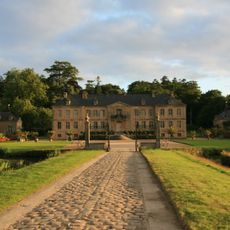
Château de Servigny is a dwelling built in the 16th and 17th centuries and heavily remodelled in the 19th century, standing in Yvetot-Bocage in the Manche. It takes the form of a main house flanked by two pavilions: the main pavilion, built in 1683 and projecting forward, opens through two basket-handle arched doors, while the north pavilion is flanked by four turrets. A crenellated 16th-century porch with two pointed-arch wooden doors survives, and a stair turret from a 14th-century manor remains at the rear.
Built in the 16th century, the estate was sold in 1629 for 23,000 livres to Guillaume Plessard, king's prosecutor in the Valognes viscounty. In 1740 it passed to René Abaquesné de Parfouru; in the second half of the 19th century Gaston Abaquesné de Parfouru and Marie-Charlotte de Mésenge had it enlarged by Rouen architect Eugène Barthélémy, work finished in 1880. On 26 June 1944 General Lawton Collins, whose headquarters were here, forced General von Schlieben to sign the surrender of Cherbourg in a first-floor salon.
The château's name comes from the Servigny estate, bought in 1629 for 23,000 livres by Guillaume Plessard, king's prosecutor in the Valognes viscounty. In the garden stand two greenhouses, the larger bearing the monogram "PM" for Parfouru/Mésenge. The attached farm retains stables, a dairy, a cider press and a henhouse. Jules Barbey d'Aurevilly probably set the plot of his tale Le bonheur dans le crime, from Les Diaboliques, here.
The château is a private property, opened to the public only on rare occasions, notably ceremonies commemorating the liberation of Cherbourg. Weekly rental is now offered. The grounds lie 1 km northeast of the Saint-Georges church in Yvetot-Bocage, in the Manche department.
The 26 June 1944 surrender of Cherbourg was signed in a first-floor salon whose decor is protected; the room was listed with the facades and roofs by decree on 7 November 1979. The document is known as the traité de Servigny. General Lawton Collins returned to the château for the D-Day anniversaries in 1974 and 1984.
The community of curious travelers
AroundUs brings together thousands of curated places, local tips, and hidden gems, enriched daily by 94,004 contributors worldwide.