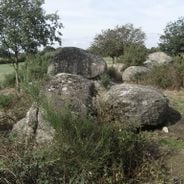
Pierre aux Fées, Neolithic menhir in Saint-Micaud, France
Pierre aux Fées is a menhir of silicified arkose standing 6.35 m tall and weighing about 15 tonnes, moved 37 m west of its original site in 1911 and re-erected beside the road in Saint-Micaud. Its weathered face carries a serpentine carving 4.20 m long with eight undulations ending in a trident, plus a circle with appendages and, visible only in raking light, a crook, a U-shape and other eroded signs.
The Cassini map shows two standing stones about 5 m apart in Saint-Micaud. One was toppled in the early 19th century and broken up for building material; the second fell on the night of 24–25 January 1871 after a thaw and was buried three years later. Victor Berthier had it dug out and re-erected 37 m west along the road on 28 February 1911, and it was classified as a monument historique on 26 August 1928.
Local folklore describes a peasant couple who were turned to stone after showing disrespect to a religious procession in the area. This legend continues to shape how people in the region understand and talk about the site today.
The stone stands close to the center of Saint-Micaud with clear pathways making it easy to reach. The site is open and accessible, allowing visitors to approach the monument from different angles.
The serpentine carving runs 4.20 m down the stone, with eight undulations that grow progressively geometric and end in a trident. Halfway along it sits a circle with appendages. Below, a U-shape and crook-like signs appear only in raking light.
The community of curious travelers
AroundUs brings together thousands of curated places, local tips, and hidden gems, enriched daily by 92,789 contributors worldwide.