Château de Lantenay, Heritage castle in Lantenay, France.
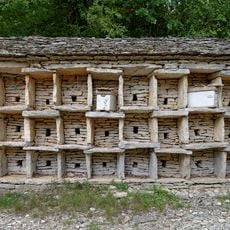
Château de Lantenay stands on a hillside at the eastern edge of the village. It consists of two L-shaped building ranges; the west facade is framed by two large square pavilions, each holding a staircase with a wrought-iron railing, one of them a single-flight spiral stair. In the inner courtyard, a nymphaeum is set into the retaining wall of a balustraded terrace restored around 1990. The 19th-century English-style park contains a dovecote, an old chapel with lava-stone roofs and a 17th-century pavilion.
The castle was built in the 17th century on the remains of a medieval fortress from the 12th century after Jean Bouhier acquired the estate in 1619. This reconstruction shaped the structure that still dominates the landscape around Lantenay.
The château's name changed with its owners: the seigneury of Lantenay and Pasques was made a marquisate in June 1677 for Benoît-Bernard Bouhier under the name Beaumanoir, then renamed Bouhier by letters of December 1724 for his son Antoine-Bernard. Antoine-Bernard continued the decoration of the interiors, and the 18th-century decoration was later reconstituted.
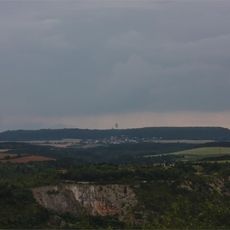
The château stands on the hillside at the eastern edge of Lantenay village, in Côte-d'Or, about 16 km from Dijon. It is a private property with no public car park or visitor facilities mentioned in the sources; the grounds, nymphaeum, terrace and 19th-century English park are seen from outside or on arranged visits.
The nymphaeum is set into the retaining wall of a balustraded terrace restored around 1990, where the 18th-century decoration of Antoine Bouhier was recreated. The nymphaeum, terrace wall and balustrade, ice house and garden pavilion were classified on 5 August 1988.
The community of curious travelers
AroundUs brings together thousands of curated places, local tips, and hidden gems, enriched daily by 94,663 contributors worldwide.