Château de Verderonne, Historic castle in Verderonne, France
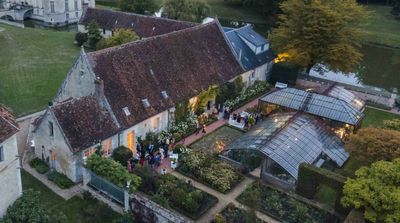
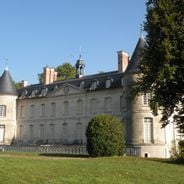
Château de Verderonne is a stone château on an island in a large pond, its main south-west facade of dressed stone built on nine bays, with a slightly projecting central block topped by a pediment and two round towers at the ends, survivors of a 13th-century castle. The building has one storey under a mansard roof, with a central wing and two shorter wings set at right angles at the rear. The perron has a double-revolution staircase, and inside the main staircase keeps its wrought-iron railing.
The seigneurie of Verderonne was established in 1240, when the knight Simon de Villers-Saint-Paul received a fief from Alphonse III of Portugal and Mathilde de Dammartin. The Villers-Saint-Paul family sold it in 1575 to the baron de Gesvres, who ceded it to the Laubespine family in 1586; a new château was built on the foundations of a 13th-century fortified castle, of which the two round towers at the ends of the south-west facade remain. Construction of the present château was completed in 1725 under Etienne-Louis, marquis de Beaucourt et de Verderonne.
The castle shows how French nobility lived in the 18th century, with its grand staircase and formal rooms reflecting aristocratic taste of that era. Walking through these spaces, you see how the owners arranged their lives around display and comfort, using different rooms for dining, conversation, and private retreat.
The château is a private hotel and event venue, so it is not open to casual visitors; access is by arrangement for seminars and receptions. From the public road, the octagonal dovecote on rue du Château, the building called la Tour and the saut-de-loup on chemin de la Tour are visible. The château itself can only be glimpsed from chemin de la Tour, as the approach drive from place des Tilleuls in Courincourt is not straight.
The access drive starts at the Place des Tilleuls in the hamlet of Courincourt and is not straight, so the château cannot be seen from its gate; only a partial view is possible from the rural chemin de la Tour toward Rosoy. Of the many protected outbuildings in the park, only three are visible from public ground: the octagonal dovecote on rue du Château, the building called la Tour, and the saut-de-loup on chemin de la Tour.
The community of curious travelers
AroundUs brings together thousands of curated places, local tips, and hidden gems, enriched daily by 92,789 contributors worldwide.