Pétroglyphes de Montravail, Petroglyph site in Sainte-Luce, Martinique
The Montravail petroglyphs are a rocky chaos of five andesite blocks bearing carvings across an area of 18 by 8 metres. The main block, 1.64 m high and 2.04 m long, shows 13 stylised faces with eyes, outline, nose and mouth; a fourteenth face is carved at its top. The central face has a trident-shaped mouth, and the other faces seem arranged along the rock's natural fissures.
Jean Crusol, an economist born in Sainte-Luce, first reported the site in 1970 to Mario Mattioni, director of the Martinique museum of archaeology and popular traditions. Mattioni made the first surveys of the main rock's petroglyphs and presented them in 1971 at the IVth International Congress on Pre-Columbian Civilizations of the Lesser Antilles in Saint Lucia. The site was inscribed as a monument historique on 7 November 1996.
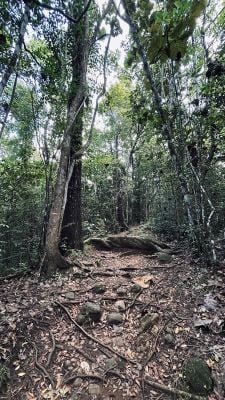
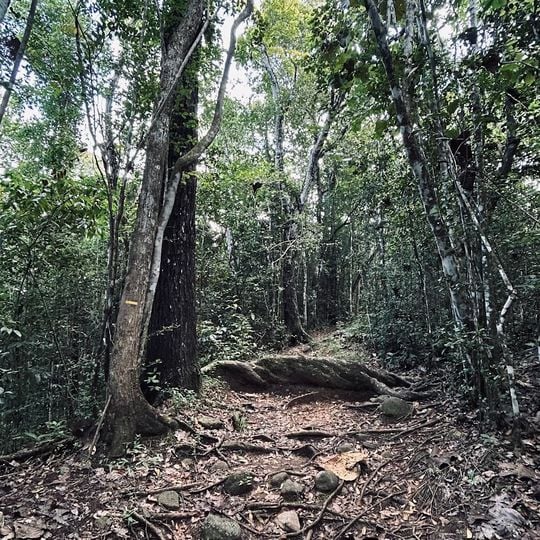
The site lies near the Montravail forest, about 3.5 km from Martinique's south coast at roughly 200 m altitude. The land belonged to the Chou family before the conseil général bought it in 2009 for a cultural tourism project. The faces were made by pecking and hammering the andesite.
The site is outdoors and freely accessible, but visitors should watch their step as the blocks sit on natural ground. Bringing water and wearing proper footwear is wise, since the terrain can be uneven.
The main block, 1.64 m high and 2.04 m long, carries 13 carved faces, with a fourteenth cut at its summit. The central face has a trident-shaped mouth, and the other faces seem arranged along the rock's natural cracks.
The community of curious travelers
AroundUs brings together thousands of curated places, local tips, and hidden gems, enriched daily by 92,937 contributors worldwide.