Château de Monchoix, Château in Pluduno, Côtes-d'Armor, France
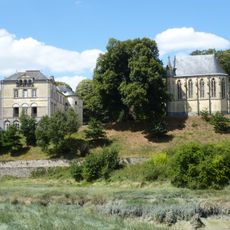
Château de Monchoix is a large stone building in Pluduno, Côtes-d'Armor, built in 1759. Its rough brown and tan walls show patchy plaster and exposed masonry, with light stone quoins at the corners. A steep gray slate roof carries a row of small dark-framed dormer windows, and pale stone chimneys rise at the left and right ends. Rectangular windows with light stone surrounds are arranged across the upper and lower facades.
Built in 1759 for Count Antoine de Bédée, maternal uncle of François-René de Chateaubriand, the château is not medieval. The adolescent Chateaubriand called it "a true paradise". It was inscribed as a monument historique by decree of 22 July 2004.
The château was built in 1759 for Count Antoine de Bédée, maternal uncle of François-René de Chateaubriand. The adolescent Chateaubriand called it "a veritable paradise", a phrase tied to this building rather than to any medieval past. The name Monchoix, "my choice", is the name the place carries in Pluduno.
The château stands in the commune of Pluduno, in the Côtes-d'Armor department of Brittany; the coordinates place it in the Val-d'Arguenon area. It is a private building, so visitors view the rough brown and tan stone walls, light stone quoins and gray slate roof with dormer windows from outside. Approach by road from Pluduno; the surrounding countryside is open and built-up services are few.
Chateaubriand, then an adolescent, called the newly built château "a veritable paradise". His maternal uncle, Count Antoine de Bédée, had it built in 1759, and the future writer stayed there as a young man. The building was inscribed as a monument historique on 22 July 2004.
The community of curious travelers
AroundUs brings together thousands of curated places, local tips, and hidden gems, enriched daily by 94,313 contributors worldwide.