Halle aux grains d'Aix-en-Provence, 18th-century grain hall in Aix-en-Provence, France.
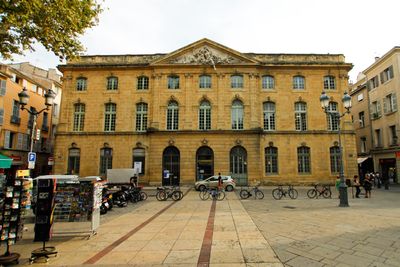
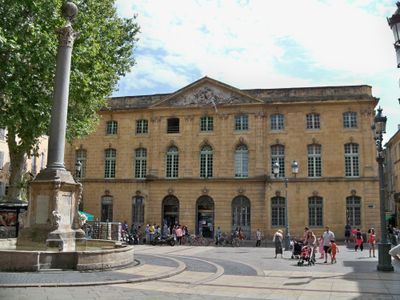
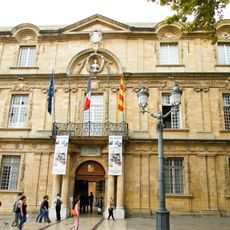
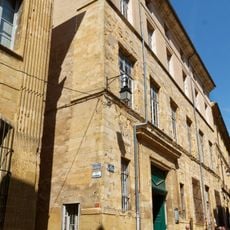
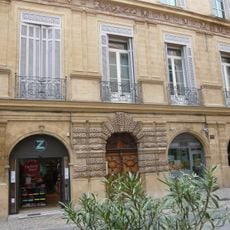
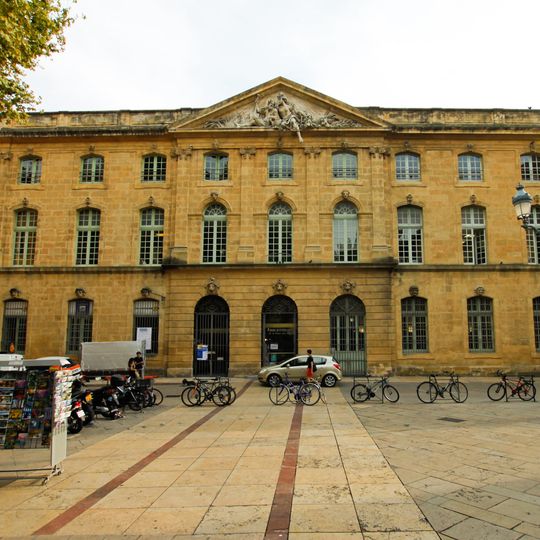
The halle aux grains d'Aix-en-Provence stands between the place de l'Hôtel-de-Ville and the place Richelme. Its pale tan and ochre stone facade has a projecting central bay with four columns between three tall arched doorways, rows of square and arched windows, and a triangular pediment with carved figures. A rusticated base with arched doorways runs along the ground.
A first grain store was built in 1718 at the corner of rue Donalari, now rue Vauvenargues. Too small, it was enlarged from 1759 by a new building designed by Georges Vallon, whose final inspection took place on 5 July 1766; the total cost reached 54,696 livres. From 1896 to 1922 the hall housed Aix's Bourse du Travail.
The grain market gave the building its name, and the square beside it, Place Richelme, still hosts a daily food market. The facade decoration, including the allegorical group of the pediment, was entrusted to the sculptor Jean-Pancrace Chastel, an Avignon native settled in Aix. From 1896 to 1922 the hall housed Aix's Bourse du Travail, the labour exchange, before it moved to 4 boulevard Notre-Dame.
The hall stands between Place de l'Hôtel-de-Ville and Place Richelme, with its 1718 wing at the corner of Rue Vauvenargues, formerly Rue Donalari. From 1896 to 1922 it housed the Bourse du Travail, the city's labour exchange, before that body moved to 4 boulevard Notre-Dame, now boulevard Jean-Jaurès. The facades and the pediment group are visible from the surrounding squares.
The pediment sculpture is by Jean-Pancrace Chastel, a sculptor from Avignon who settled in Aix a few years before the work. He was paid 1,500 livres in fees on 13 March 1767, when the city council settled the accounts of Georges Vallon's building.
The community of curious travelers
AroundUs brings together thousands of curated places, local tips, and hidden gems, enriched daily by 94,365 contributors worldwide.