Museum d'Histoire Naturelle Aix-en-Provence, Natural history museum in Hôtel Boyer d'Éguilles, Aix-en-Provence, France.
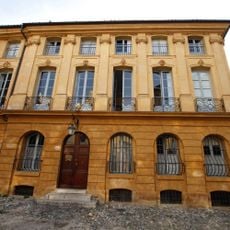
The Museum d'Histoire Naturelle Aix-en-Provence occupied the Hôtel Boyer-d'Éguilles, a 17th-century mansion, until 2014. The building's ochre stone facade has a rusticated ground level with three low arched windows, above which are two rows of three large rectangular windows with white multi-pane frames. A double door with glass panes, reached by stone steps, sits on the left; carved corbels and decorative panels separate the window rows.
A geologist established the museum in 1838 and it opened to the public shortly thereafter. The building itself dates from earlier centuries and has long served as the home for this scientific collection.
The museum's name honours its origins: in 1838 Madeleine Carle, widow of an Aix pharmacist who collected exotic birds, offered his cabinet to the city, and Mayor Antoine Aude founded the collection under geologist Henri Coquand. Aix scientists such as Hippolyte de Fonscolombe and Gaston de Saporta's father added their own specimens. The 1892 bequest of Louise Rostan d'Abancourt, with minerals, fossils, shells and prehistoric objects, revived the institution.
The collections are currently not accessible in their full form as they have been relocated from their original home. Visitors should check ahead, as plans exist for reopening at a new location.
The museum's palaeontology holdings exceed 70,000 specimens, begun with Victor Coquand's donation at the 1838 founding. Among them are remains of a Rhabdodon found at Vitrolles and a titanosaur from Trets. Dinosaur eggs discovered in the Sainte-Victoire massif in the 1950s, the only such find in France, brought the museum wide attention.
The community of curious travelers
AroundUs brings together thousands of curated places, local tips, and hidden gems, enriched daily by 94,557 contributors worldwide.