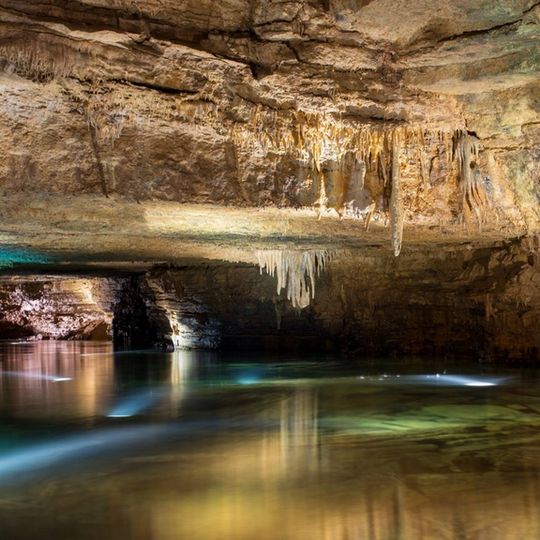
Grottes de Bèze, Underground cave system in Bèze, France.
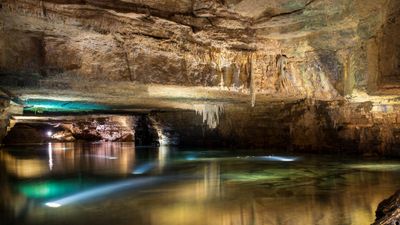
The Grottes de Bèze is a karst network in Upper Jurassic limestone with a known development of over 2,800 metres and a vertical range of 26 metres. Visitors enter through the Salle de la Crétanne, then pass the Salle de l'Embarcadère, whose three siphons and a chimney frame a ring of stalactites, before following a 150-metre underground river section by boat and on foot. The tour ends at the Salle Blanc, named after its discoverer, which holds a siphon linked to the Venelle and two chimneys.
The Crétanne chamber, the first room reached from outside, served as a hiding place for the villagers of Bèze during the Viking invasion of 888. The navigable underground river was discovered in September 1950, and from 1953 divers explored its siphons and found extensions. The known network now runs over 2,800 metres with a 26-metre drop.
The cave shelters cave-dwelling crustaceans of the genera Niphargus, Caecosphaeroma and Proasellus, including the Aselle de Bourgogne, an endemic species of Burgundy. Fish have also been observed there, and several bat species take refuge in winter. The deepest sump on the tour, the "siphon des Belles Mères", is named after a local legend.
Visits run from April to the end of October, on foot and by boat, lasting about 55 minutes and adapted when the cave floods or dries out. Groups average 20 people, with up to 500 visitors a day and opening from 10 a.m. to 17 p.m. The tour ends at the siphon des Belles Mères, the deepest in the cave.
In June 2024, cave divers photographed a fossil in the siphon that had been known since the 1990s; 3D assembly let specialists identify a 150-million-year-old plesiosaur flipper. The cave's known development exceeds 2,800 metres for 26 metres of vertical drop.
The community of curious travelers
AroundUs brings together thousands of curated places, local tips, and hidden gems, enriched daily by 94,660 contributors worldwide.