Champ de Roches, Geological formation in Barbey-Seroux, France.
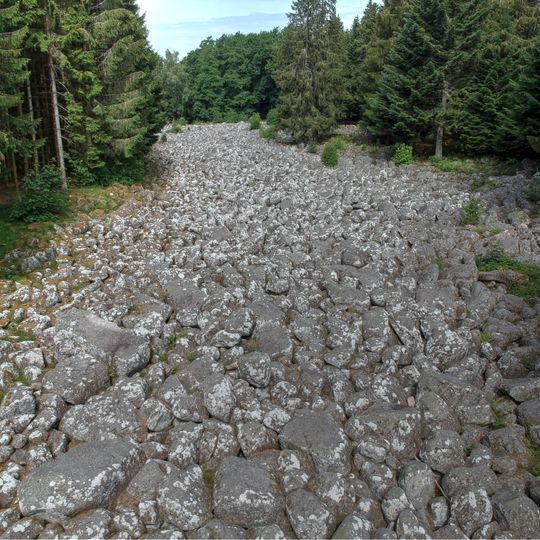
Champ de Roches is a 400-metre-long, 40-metre-wide "river" of rock in the forest above Barbey-Seroux, near the col des Arrentès between the Neuné and Vologne valleys. The deposit is 7 to 8 metres deep, which is why no trees grow on it. It consists mainly of granite, with some sandstone and gneiss; the blocks are angular, packed densely and often covered with pale grey-green lichen, and a hiking path goes around it.
The stone field formed from moraine deposits left by a glacier during the quaternary period that retreated as temperatures rose in the Vosges region. This glacial legacy reveals the ice age history of the landscape.
The site lies in the forest between the Neuné and Vologne valleys, near the col des Arrentès, on the land of Barbey-Seroux. A hiking path circles the 400-metre-long stone river, so walkers pass close to the blocks and the lichen-covered surfaces. The unexplained absence of friction marks on stones of similar size is the detail visitors most often discuss.
A hiking trail runs around the edge of the 400-metre-long, 40-metre-wide stone river, so the whole field can be circled on foot. The site lies near the col des Arrentès, between the Neuné and Vologne valleys, in the forest of Barbey-Seroux.
The granite blocks show no scratch marks or wear despite lying together for ages, raising questions about how they arrived at this spot. Their uniform size and lack of friction marks present a puzzle that scientists still find difficult to explain completely.
The community of curious travelers
AroundUs brings together thousands of curated places, local tips, and hidden gems, enriched daily by 92,882 contributors worldwide.