Gallo-Roman theatre of Sanxay, Ancient Roman theatre in Sanxay, France.
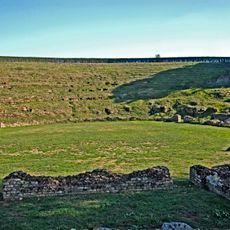
The Gallo-Roman theatre of Sanxay is a spectacle building set into the concave left bank of the Vonne, with an outer diameter of 88.60 m and a nearly circular orchestra 37.80 m across. Its cavea, sloping about 40% on the main axis, rests on curved opus vittatum walls of limestone built directly on the rock; these carried wooden seating, attested by nails found in the excavations. The cavea extends beyond a semicircle, and no stage building closes the back of the stage.
The construction date is uncertain, estimated between the mid-1st and 3rd centuries. The site was gradually abandoned in the 3rd and 4th centuries, possibly after a fire. The first major excavation was led by Belgian archaeologist Camille de La Croix from 1881 to 1883, and the remains were classified as historical monuments in 1882.
The theatre belongs to the mixed Gallo-Roman buildings found only in Gaul, mostly in rural sanctuaries, and its layout allowed varied shows. It faces northwest toward the sanctuary's cult buildings across the Vonne, including a tholos that vanished in the 19th century. A small structure under one metre high at the orchestra's far edge is likely the base of an altar or small temple.
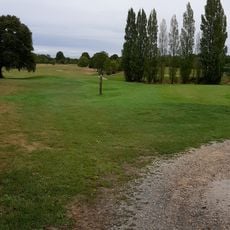
The orchestra sits only about a metre above the average level of the Vonne, which runs almost at the foot of the theatre, so the floor can flood after heavy rain. The cavea slope averages 40%, and the two main aisles are 4 m wide; allow time to walk the whole circuit. The ruins are reached from the hamlet of Herbord.
The orchestra holds a spring, yet excavations found no structure built to collect its water. At the far edge of the orchestra stands a small masonry base, no more than a metre high, taken to be the footing of an altar or a small shrine.
The community of curious travelers
AroundUs brings together thousands of curated places, local tips, and hidden gems, enriched daily by 92,800 contributors worldwide.