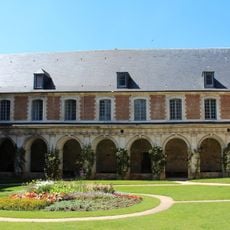
Argoules Valloires abbey, Historical pipe organ in Valloires Abbey, France.
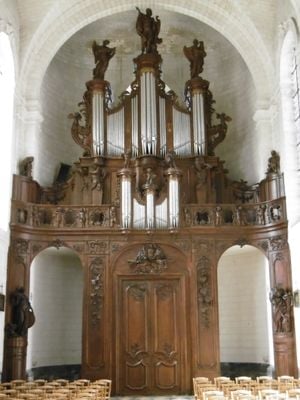
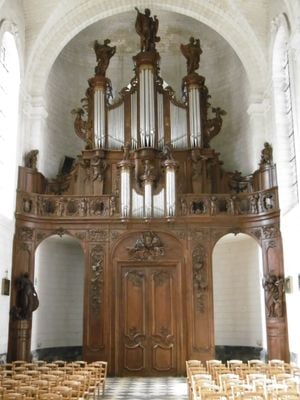
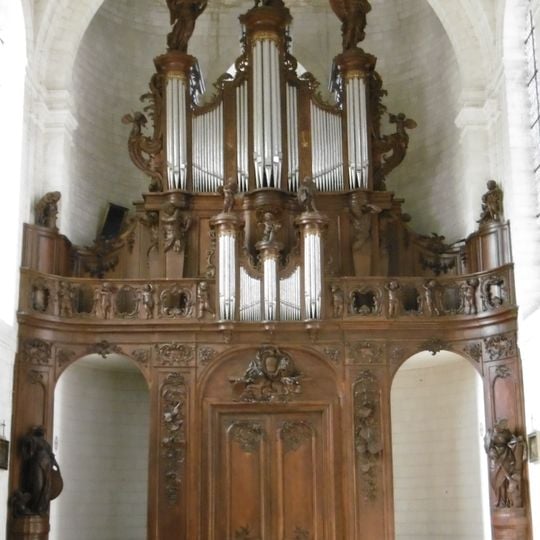
The Valloires Abbey organ stands on the west wall of the abbey church nave in Argoules. Its case of carved oak and lime wood, made by Simon Pfaff de Pfaffenhoffen, has a paneled base with a central double door and two arched side openings, carved figures at the corners, and a balustrade of carved figures above. Three groups of silver metal pipes rise behind the balustrade, the central group taller than the two outer ones, with carved scrollwork and figures on top.
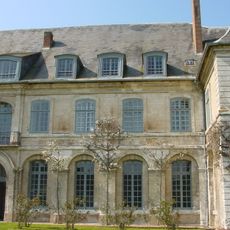
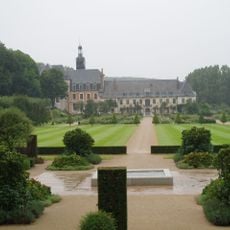
The abbey church was rebuilt from 1741 to 1756 after Spanish troops ravaged the earlier building in the 17th century. Simon Pfaff de Pfaffenhoffen, an Austrian baron in exile, carved the oak and lime wood organ case. The instrument, credited to Charles Dallery or his father, had 22 stops and two keyboards. In 1845 the Basilian brothers rebuilt it with 32 stops and a third expressive keyboard.
The organ case and gallery were listed as historical objects on 29 September 1907. The instrument was restored in 1993 by organ builder Théo Haerpfer to recover the Basilian organ, and Marie-Claire Alain inaugurated it. It is tuned to the original pitch of 392 Hz with unequal temperament.
The organ stands on the west wall of the nave, not in the centre of the church, so look toward the back wall on entering. Its console sits behind the case, in a window recess, and is not visible from the nave. The instrument is tuned to its original pitch of 392 Hz with unequal temperament.
The 1993 restoration by organ builder Théo Haerpfer kept most of the 19th-century pipework and four stops from the 17th and 18th centuries. The organ is tuned to its original pitch of 392 Hz with unequal temperament, and Marie-Claire Alain inaugurated the restored instrument.
The community of curious travelers
AroundUs brings together thousands of curated places, local tips, and hidden gems, enriched daily by 94,051 contributors worldwide.