Écluse Notre-Dame-de-la-Garenne, Lock system on the Seine River in Saint-Pierre-la-Garenne, France.
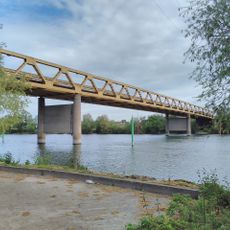
The Écluse Notre-Dame-de-la-Garenne is a lock, dam and hydroelectric complex on the Seine between Saint-Pierre-la-Garenne and Port-Mort, 40.495 km upstream of the Poses dam. Its 201 m of installations run from the power station and a six-pass dam (two navigable) past Île Besac and a fish lift to four parallel locks, the largest 185 m long and 24 m wide. The dam holds a 4 m head; the green steel structure in the photograph is the lock building, with a truss footbridge and spiral stair alongside.
Construction of the lock took place between 1879 and 1889 under engineer Émile Nouguier's direction, marking a milestone in applying metal and concrete technologies to the Seine. The project demonstrated how 19th-century engineers transformed rivers for both navigation and power production.
The painter Adrien-Jacques Sauzay (1854–1928) left a canvas titled Vieille écluse de Notre-Dame de la Garenne, showing the site as a subject for artists. The lock is still worked by seven lock-keepers and eleven maintenance agents, and about 24 vessels of all kinds pass through daily, including pleasure boats.
The lock operates continuously and is staffed to manage boat traffic through the chambers throughout the day. Visitors can watch the system in action from the riverside paths, which offer good vantage points to see how vessels move through the waterway.
Since 2008, a fish ladder has been installed to allow salmon and eels to bypass the barriers and swim upstream through the system. This addition reflects how contemporary engineers adapt infrastructure to protect river ecosystems.
The community of curious travelers
AroundUs brings together thousands of curated places, local tips, and hidden gems, enriched daily by 93,010 contributors worldwide.