Château de Montsoreau-Museum of Contemporary Art, Art museum in Loire Valley, France.
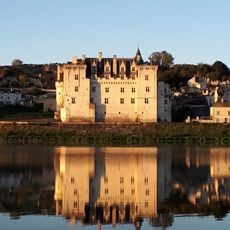
Château de Montsoreau is a pale stone castle built between 1443 and 1453 directly in the Loire riverbed, with a tall rectangular block, a steep slate roof and a square tower with a pointed roof on the right. Its white facade has rows of rectangular windows, some with pale shutters, set unevenly where a lower wing projects forward. The building stands on a stone base close to the water and houses the museum's galleries on its first two floors.
The rock of Montsoreau held a Gallo-Roman temple and a fortress built around the year 1000 by Foulques Nerra. Jean II de Chambes, ambassador of Charles VII in Venice, built the present castle between 1443 and 1453 after demolishing the medieval fortress. From 1956 to 1999 it housed the Museum of Moroccan Goums; the contemporary art museum opened on 8 April 2016.
The castle houses one of the world's largest collections of Art & Language works, a group that has explored conceptual art through text and image since the late 1960s. Walking through the galleries, visitors encounter pieces that challenge what art can be and how ideas become visual form.
The museum occupies the château on the Loire bank; the château port reopened at the end of May 2017 after several months of work, so visitors can arrive by boat. The Philippe Méaille collection is installed on the first two floors. An art library opened in August 2016. The wild garden covers more than one hectare.
The castle is notable for being built directly over the Loire riverbed, a placement that can result in partial flooding during high water periods and has shaped its structural features over centuries. This unusual positioning makes it one of the few Loire Valley châteaux to have such a direct physical relationship with the river that defined the region.
The community of curious travelers
AroundUs brings together thousands of curated places, local tips, and hidden gems, enriched daily by 94,663 contributors worldwide.