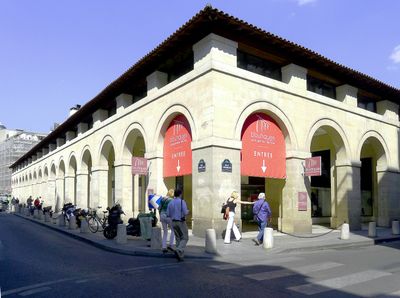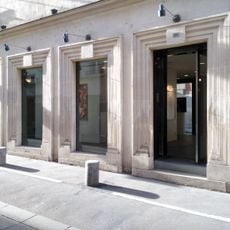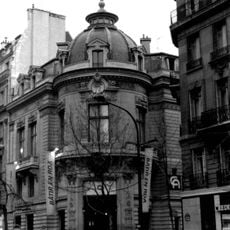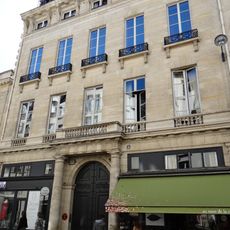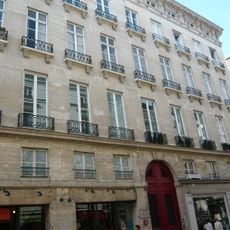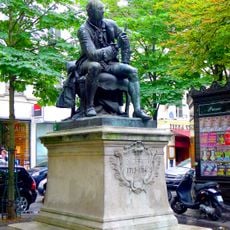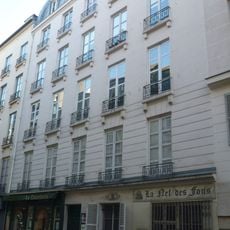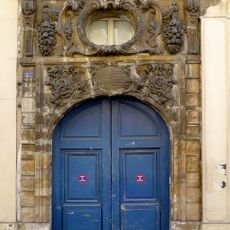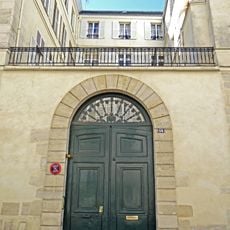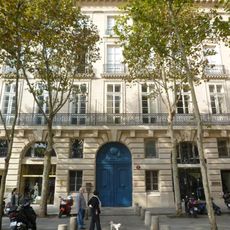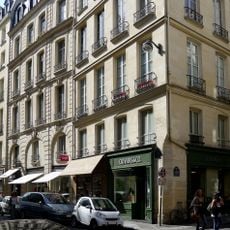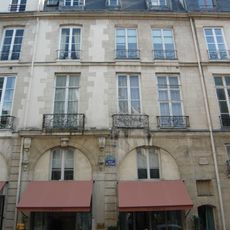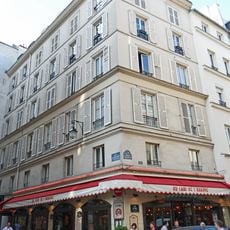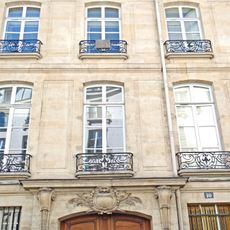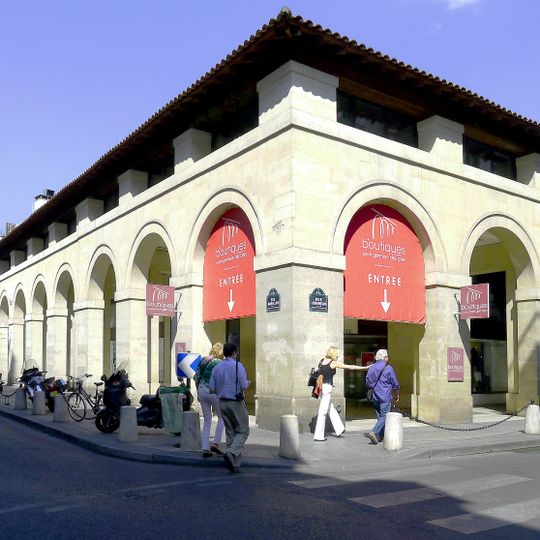
Marché Saint-Germain, Market hall in Quartier de l'Odéon, France.
The Marché Saint-Germain is a market hall with a rectangular building that features curved arcades and an inner courtyard. Inside, shopkeepers occupy both public and private sections where they sell food and goods throughout the week.
The market and the Foire Saint-Germain both depended on the Abbey of Saint-Germain-des-Prés. In 1511 Abbot Guillaume Briçonnet had a double-roofed hall built for 300 merchants; it burned down in 1762. Napoleon I decreed a replacement in 1811, and Jean-Baptiste Blondel designed the new building, erected 1813–1817, with four galleries around a 6,900 m² rectangle. The courtyard was roofed in 1860 at the traders' request under Napoleon III.
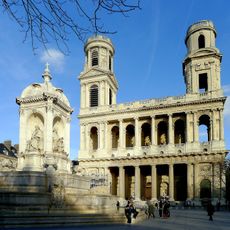
The name comes from the abbey of Saint-Germain-des-Prés, on which both the market and the old Saint-Germain fair depended. The covered courtyard added in 1860 housed a "Maison du Livre" from 1898 and a "Maison des Examens" from 1950. Since the 2017 reopening, the food hall of 1,635 m² remains in the south-east corner, beside international stores.
The market occupies a 92 by 75 metre rectangle between Rue de Seine, Rue Lobineau, Rue Mabillon and Rue Clément, with entrances through the stone arcades on all four sides. The food hall, about 1,635 m², sits in the south-east corner; the rest of the covered gallery is given over to large shops opening directly onto the arcades.
In 1975, fifteen interior and four exterior arcades were dismantled and stored in the Bercy warehouses. When the Parc de Bercy was laid out in 1993, they were reused in the Jardin des Philosophes, and stones from the market also went into the Amphithéâtre de Flore and the steps leading to Rue Joseph-Kessel.
The community of curious travelers
AroundUs brings together thousands of curated places, local tips, and hidden gems, enriched daily by 93,224 contributors worldwide.