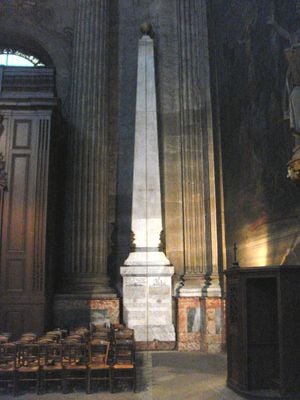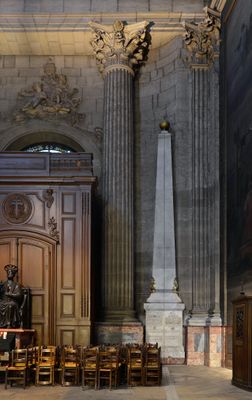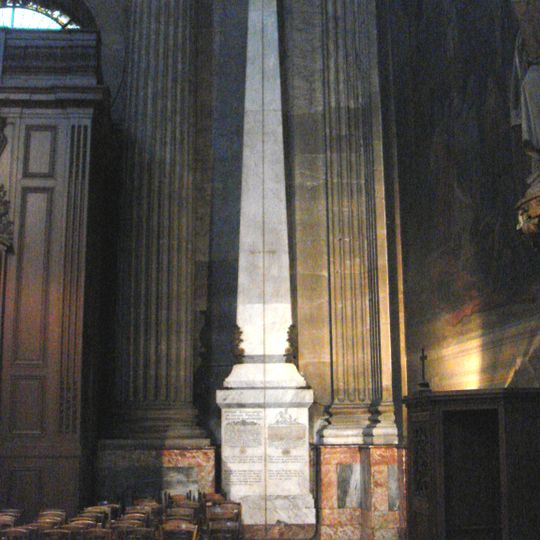
Gnomon of Saint-Sulpice, Astronomical instrument in Saint-Sulpice Church, France
The Gnomon of Saint-Sulpice is an astronomical measuring device inside the church that combines a brass line on the floor, a marble obelisk, and an opening in a high window. This arrangement allows sunlight to travel across the floor line throughout the year, creating a moving shadow that tracks the sun's path at different seasons.
The device was built in 1714 by Henry Sully, an English clockmaker, under the supervision of priest Jean-Baptiste Languet de Gergy. It emerged during a period when churches used scientific measurement to calculate important religious dates with greater accuracy.
The device represents the fusion of religious practices and scientific advancement during the Age of Enlightenment through its role in determining Easter dates.
The instrument is located inside a church that is open daily and accessible through multiple entrances. The best time to observe it is on sunny days, when sunlight clearly hits the floor line and makes the effect easy to see.
The light spot created by the sun moves differently across the floor line depending on the season, displaying the sun's changing path throughout the year. This subtle visual effect is often overlooked by visitors, yet it reveals the purpose of the entire design.
The community of curious travelers
AroundUs brings together thousands of curated places, local tips, and hidden gems, enriched daily by 91,374 contributors worldwide.