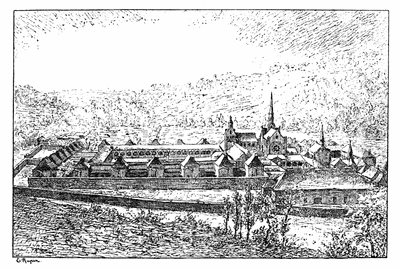
Chartreuse de Glandier, Carthusian monastery in Beyssac, France
The Chartreuse de Glandier is a former Carthusian monastery in Beyssac, Corrèze, rebuilt in the late 19th century and reworked through the 20th. Its church carries a rose window and a slender spire, beside a square tower with a pyramidal roof; pale grey and brown walls with steep dark roofs and gables stand among trees on a hillside.
The monastery was founded in 1219 by Archambaud VI, Viscount of Comborn, and existed through two active periods: from 1219 to 1789 and again from 1860 to 1901. The gap between these periods reflects the major upheavals that affected religious communities across Europe.
The monastery was one of only two Carthusian sites in the former Limousin region, embodying monastic ideals of solitude and silence. Visitors can still recognize today how the spatial layout supported this life of withdrawal from the world.
The grounds are today privately owned and managed by current proprietors. Visitors should inquire in advance whether access is possible and what conditions apply for a visit.
In 1840 Marie Lafarge, a young woman of aristocratic descent, was tried and convicted of poisoning her husband Charles Pouch-Lafarge, then the lay owner of the monastery; the case was widely reported and later retold in films, television dramas and books.
The community of curious travelers
AroundUs brings together thousands of curated places, local tips, and hidden gems, enriched daily by 92,825 contributors worldwide.