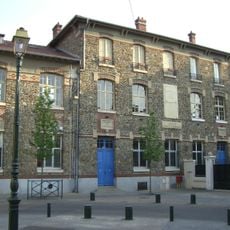
Pavillon de Haïti-Hawaï, Historical pavilion in La Garenne-Colombes, France.
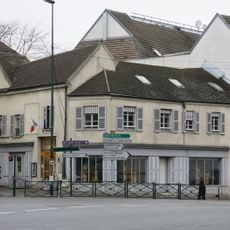
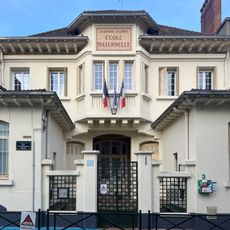
The pavillon de Haïti-Hawaï is a two-storey timber-framed house at 13 rue Auguste Buisson, with cream walls, dark beams and a steep tiled gable roof. Its upper floor is set back and divided into timber panels, and the ceramic panels of the first-floor facade remain in place. The projecting pediment that carried the arms of Hawaii is gone, though its position can still be made out in front of the two facade windows.
The building was originally commissioned in 1889 by Haiti for the Paris Universal Exhibition but was sold to the Kingdom of Hawaii before the event took place. After the exhibition ended, the structure was dismantled and reconstructed as a private residence in La Garenne-Colombes, where it still stands.
The ceramic panel on the facade, cleaned during restoration, again reads "Haïti", a trace of the building's first purpose. Haiti's name and Phrygian caps were covered over and the Haitian arms on the pediment replaced by those of Hawaii before the 1889 opening. The pavilion was shown at the musée Roybet-Fould from November 2019 to March 2020.
The pavilion is located in a residential neighborhood, so visitors should respect the privacy of residents and view it from the street. It is best to visit during daylight hours to get a clear view of the ceramic details on the facade.
The link to the Hawaii pavilion was lost for decades: the building was not listed in the reference works on Universal Exhibition remains, and its origin was only rediscovered by Philippe Le Port and Françoise Mary in August 2018. A Le Parisien article of 2 January 2019 made it known to the public.
The community of curious travelers
AroundUs brings together thousands of curated places, local tips, and hidden gems, enriched daily by 93,898 contributors worldwide.