Jean-François Champollion, Marble statue in the 5th arrondissement, Paris, France
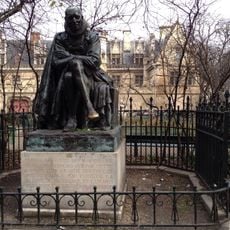
The Jean-François Champollion statue is a marble figure by Frédéric Auguste Bartholdi, erected in 1875 in the courtyard of the Collège de France. Champollion is shown standing, his left foot resting on a fragment of an Egyptian relief, and the base carries an inscription naming him decipherer of hieroglyphs. The plaster model was funded by the Egyptian government.
In 1867, Bartholdi proposed a colossal statue of Champollion for the Collège de France, but the project stalled. The Egyptian government funded the plaster model, and the marble version was inaugurated in 1875. Champollion had taught at the institution and deciphered the Rosetta Stone in 1822.
The statue honors Champollion as a key figure in Egyptology and stands within the courtyard of one of France's oldest learned institutions. The location draws people interested in the history of language research and ancient cultures.
The statue sits in the open courtyard of the academic building and is easily accessible on foot from the public street. Visitors should note that the courtyard may not be freely accessible during certain academic times.
The original plaster model received financial backing from the Egyptian government, highlighting the international importance of Champollion's legacy. This collaboration made it possible to transform the model into the marble work seen today.
The community of curious travelers
AroundUs brings together thousands of curated places, local tips, and hidden gems, enriched daily by 92,939 contributors worldwide.