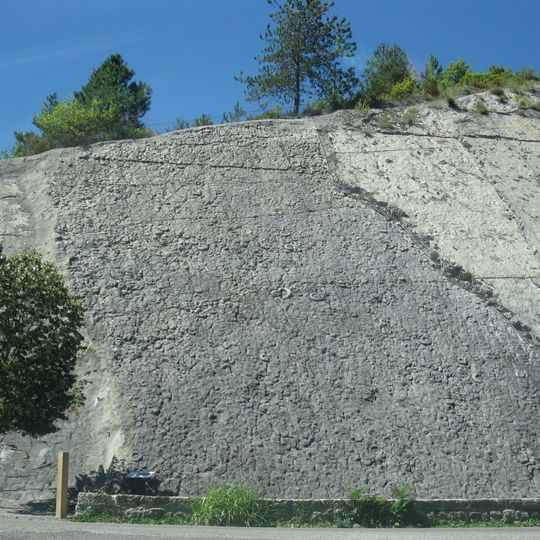
Ammonite slab, Paleontological site in Digne-les-Bains, France
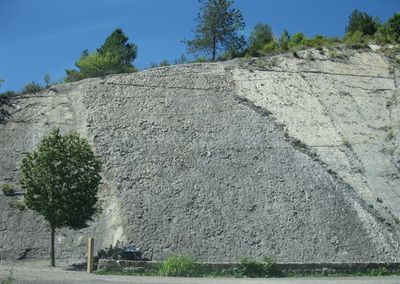
The Ammonite slab is a limestone surface containing embedded fossils of ancient marine creatures from the Early Jurassic period. The exposed rock displays hundreds of well-preserved specimens still arranged in their original positions, offering a direct window into a prehistoric ocean.
The fossils were discovered by chance in 1941 during road construction work and later studied systematically. The specimens date from a period when the region was covered by a tropical sea teeming with marine life.
The slab lies in the Réserve naturelle nationale géologique de Haute-Provence, not a UNESCO Global Geopark. Its name alternates between Dalle à ammonites and Dalle aux ammonites. In 1992 the reserve made a mould of the 160 m² then exposed for the Japanese city of Kamaishi, which wanted the original; it was cast in 30 fragments, shipped and reassembled in Japan.
The slab lies about 1.5 km from Digne-les-Bains along the Barles road (D 900A), within the Haute-Provence Geological Nature Reserve. It is an outdoor rock face beside the road, with no observation platform or accessible facilities; the inclined surface is viewed from the roadside. Fossils must not be collected or touched.
Some of the largest preserved specimens reach about 70 centimeters in diameter and belong to a species rarely found in such complete condition in the fossil record. This size and preservation quality allow scientists to study the internal shell structure without needing to remove them from the rock.
The community of curious travelers
AroundUs brings together thousands of curated places, local tips, and hidden gems, enriched daily by 92,894 contributors worldwide.