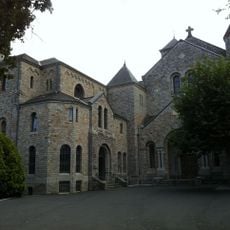
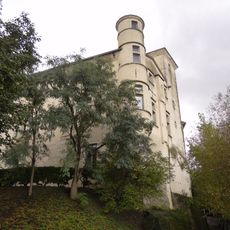
Château d'Arifat, Medieval castle in Arifat, France.
Château d'Arifat is a ruined castle whose surviving four-story main block runs east to west, with a rough tan render eroded to expose stone and brick. Its upper row has five rectangular windows and the lower row four larger openings plus a central window or door; two mullioned windows remain on the main facade. The rear wings that once extended north, with a balcony and a small round tower, have collapsed.
The castle was built in the 13th century by the Soubiran family and underwent major structural changes during the 15th and 16th centuries. These transformations shaped the form we see today.
The castle takes its name from the seigneurie of Arifadès, which also included the older Château de la Roque. In 1775 the Villeneuve family, who had acquired the seigneurie in 1763, were titled marquis d'Arifat. A buvette now occupies an annex of the ruined building, and the Association pour la sauvegarde et la promotion du site d'Arifat works to protect the medieval residence.
Access to the interior is not permitted because of the damaged roof and a wide crack in a hard-to-reach wall; the visit is limited to the exterior of the four-story main building. A small bar occupies an annex. The site stands on a promontory above the Arifat waterfalls, and the municipality has owned it since 2001.
Between 1914 and 1961, sections of the structure served as a local school, first in a separate building and later within the castle itself. This unexpected use reveals how the site adapted to community needs beyond its original purpose.
The community of curious travelers
AroundUs brings together thousands of curated places, local tips, and hidden gems, enriched daily by 92,920 contributors worldwide.