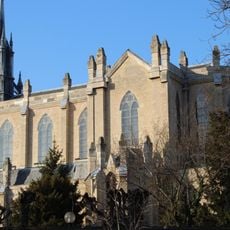
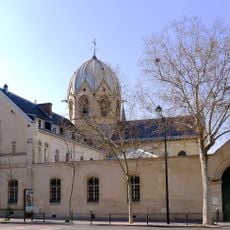
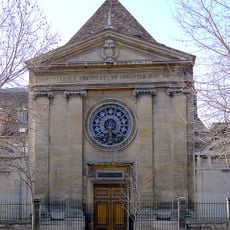
Arago telescope, Optical telescope at Paris Observatory, France
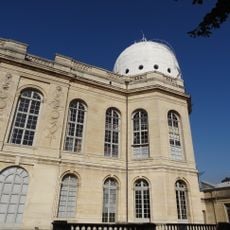
The Arago telescope is a refractor with a 38-centimeter lens installed in the east tower of the Paris Observatory. The instrument sits on an equatorial mount designed for tracking celestial objects across the night sky.
François Arago ordered this telescope from Lerebours in 1839, and it took until 1857 to complete the complex instrument. The Henry Brothers later upgraded it with an iron tube and a new objective lens in the early 1880s.
The name Lunette Arago is a modern label; 19th-century reports called it the "east equatorial" or the "38 cm refractor", after its Brunner mount and its place in the east dome. Its Breguet clock drive and moving dome floor were part of the instrument's daily use.
This telescope can be viewed during guided tours of the Paris Observatory, where staff explain its historical role in astronomical research. The best time to visit is during regular afternoon hours or special evening programs focused on the observatory's collections.
On 23 June 1878 the Arago telescope became the first instrument used to detect a moon eclipse of Jupiter photometrically, when Corunu and Obrecht recorded the event at Paris Observatory. In the 1880s it was also used for photometric work on the Galilean satellites, and between 1966 and 1971 over 1,800 double stars were observed with its 38 cm lens.
The community of curious travelers
AroundUs brings together thousands of curated places, local tips, and hidden gems, enriched daily by 93,036 contributors worldwide.