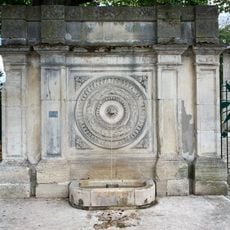
Aqueduc du Loing et du Lunain, Historic aqueduct in Cachan, France.
The Aqueduc du Loing et du Lunain is a water conduit that transports water from the Loing and Lunain rivers to Paris, using both above-ground and underground sections. The structure displays various engineering techniques to regulate and protect the water flow along its course.
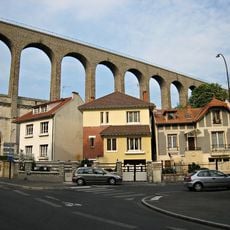
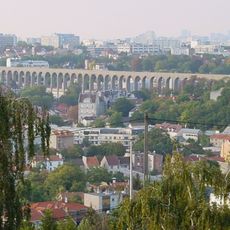
Completed in 1900, the aqueduct carries water from the Loing and Lunain rivers to Paris and joins the Vanne aqueduct in the Fontainebleau forest, at the Croix du Grand-Maître district, after the Sorques pumping station. Water takes three days to reach the Montsouris reservoir. Its central section was raised to clear the valley floor, and its foundations rest on centuries-old underground quarries beneath Avenue Aristide-Briand in Cachan, consolidated under inspector general Émile Wickersheimer with engineer Maxime Charles Joseph Pellé and controller Charles Louis Dieudonné Vallet, paid 500 francs.
The aqueduct joins the Vanne aqueduct in the Fontainebleau forest, at the Croix du Grand-Maître district, after the Sorques pumping station. Water takes three days to reach the Montsouris reservoir in Paris. East of Cachan, a shaft links it to inspection chambers 10 and 11 of the Médicis aqueduct, which crosses it at right angles.
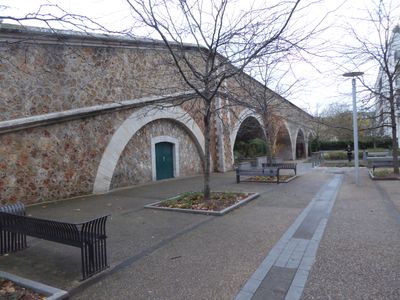
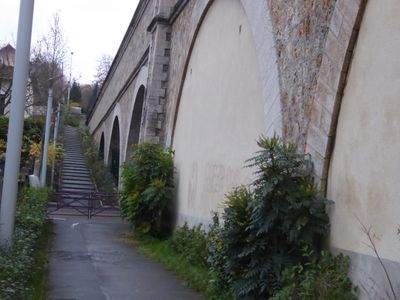
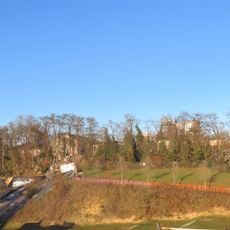
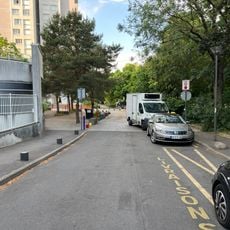
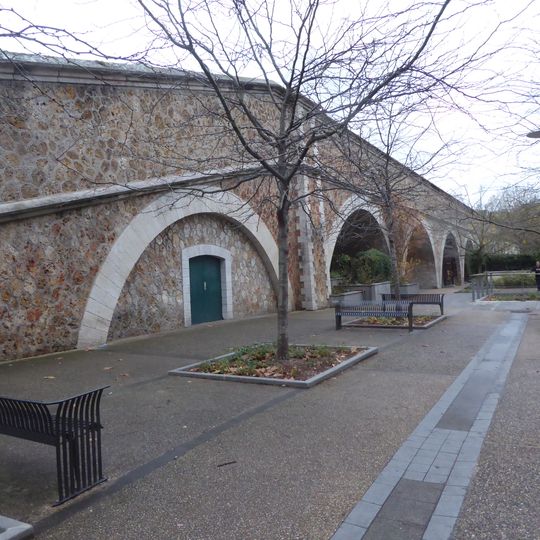
The visible arches and green doors stand along Avenue Aristide-Briand in Cachan, on the route of the D920, north of rue Jean-Marin Naudin. Most of the line runs underground as a siphon, and the raised sections are grassed over, so look for the masonry arcades rather than a continuous channel. The quarries beneath are unmapped and unsafe to enter without a specialist guide.
Beneath the channel bed lie old limestone quarries that posed a special challenge during construction. Engineers had to add special reinforcements to ensure stability over these hollow areas.
The community of curious travelers
AroundUs brings together thousands of curated places, local tips, and hidden gems, enriched daily by 93,129 contributors worldwide.