Surrounding wall of the national domain of Chambord, Stone wall of historic monument in Chambord, France.
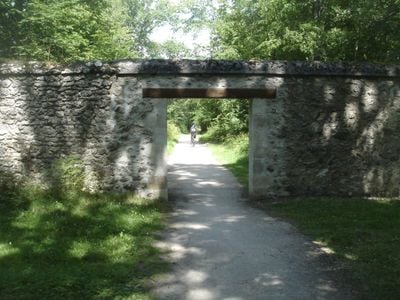
The surrounding wall of the national domain of Chambord is a 32 km stone wall enclosing the forest of Chambord in Loir-et-Cher. It stands about 2.50 m high on foundations 70 cm deep, built of small dry stones of Beauce limestone. In the photograph, a gateway with a dark wooden lintel and square stone piers interrupts the rough grey, brown and tan masonry, whose top is capped by a flat course of darker, regular stones.
Construction of the wall began in 1524, and the 32 km enclosure is described as the largest walled park in Europe. It was classified as a monument historique on 2 April 1997 as part of the protection of the Chambord national domain. By 2020 about a dozen breaches, roughly 1.5 km in total, opened the line, five of them along roads and marked by pavilions.
Six gateways, called pavilions, mark where roads cut through the wall: the pavilions of Saint-Dyé, La Chaussée-le-Comte, Bracieux, Muides and Montfrault, plus one on the route de la Commission. Near Saint-Dyé the wall is fitted with iron grilles on either side of the road. The Montfrault pavilion stands not on a road but a few metres from a breach near the allée de la Biche.
You can enter the domain through several gates built into the wall, which provide access to walking and cycling paths around the property. Bring comfortable shoes, as the routes cover substantial distances through forest and open land.
The wall's 32 km length makes it the largest walled park in Europe, yet in 2020 it had about a dozen breaches totalling roughly 1.5 km. Five of these, where roads such as the RD33 and RD112 cut through, are marked by small pavilions that officially signal the park boundary.
The community of curious travelers
AroundUs brings together thousands of curated places, local tips, and hidden gems, enriched daily by 93,752 contributors worldwide.