Dragon cave of Béraire, Medieval cave in La Chapelle-Saint-Mesmin, France.
The Dragon Cave of Béraire is a natural cavity in the Beauce limestone cliff beneath the church of Saint-Mesmin, above the Loire at La Chapelle-Saint-Mesmin. Two natural pillars of marl and limestone, plus two medieval retaining walls, divide the interior into three connected parts. In the eastern part, a late-antique staircase renovated in the 19th century rises toward the surface but stops in the clay layer.
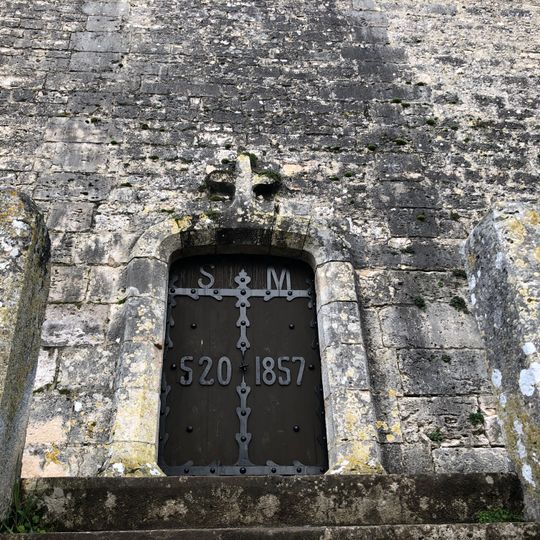
The cave sits beneath the villa Berarii, a domain of the Abbey of Micy, and legend makes it the lair of a dragon killed by Saint Mesmin, second abbot of Micy and nephew of its founder Euspice. Mesmin, who crossed the Loire to pray here, was buried in the cave at his death in 520; a chapel was built above it around 550 on the initiative of Agylus. Pilgrims came until the Norman invasions, and in 675 the relics were moved to the collegiate church of Saint-Aignan in Orléans. During the Wars of Religion the cave was walled up and forgotten for two centuries, until the Loire flood of June 1856 led to its rediscovery on 24 November 1856 by the archaeologist Ernest Pillon.
The name Béraire comes from Berarius, owner of the Gallo-Roman villa Berarii that stood on the cliff above. Legend holds the cave was the lair of a dragon killed by Saint Mesmin, a tale linked to druidic rites surviving into the early Christian era and to the draining of nearby marshes. Some authors think a chthonic cult preceded Christian worship here.
The cave opens in the cliff beside the Loire towpath, on the route of the GR3 long-distance trail and of the Via Turonensis, the Compostela pilgrim way from Paris. Inside, two medieval retaining walls and two natural pillars of marl and limestone divide the space into three connected parts. A late-antique staircase, renovated in the 19th century, rises toward the surface but stops in the clay layer.
The cave was walled up during the Wars of Religion, when the cliff under the church risked collapsing as the Loire embankment was built, and stayed forgotten for two centuries. When it was reopened, workers found medals in the rubble, the oldest dated 1613 and the newest 1649, plus a pear-shaped mason's plumb bob and five coins.
The community of curious travelers
AroundUs brings together thousands of curated places, local tips, and hidden gems, enriched daily by 93,134 contributors worldwide.