Kvelatsminda Church, Medieval Orthodox church in Gurjaani, Georgia.
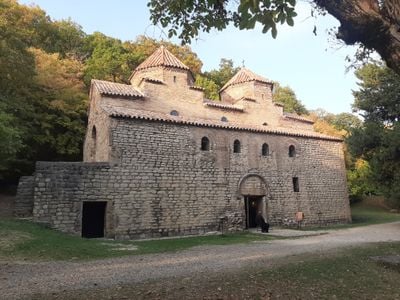
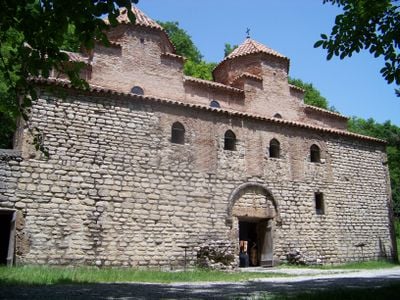
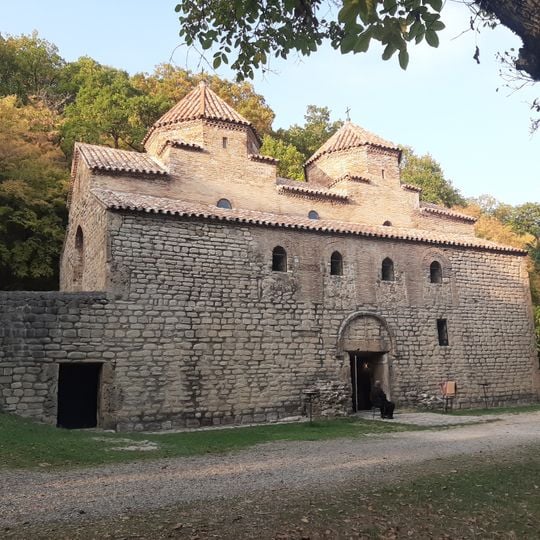
Kvelatsminda Church is a three-nave basilica with two octagonal domes, the only surviving two-dome church in Georgia. Its walls are built of cobblestone, with pumice stone at the corners and brick used for the central nave, arches, vaults and pillars. The taller western dome is slightly wider than the eastern one, and the central nave ends in a horseshoe apse.
No written source records its construction; stylistic analysis places it in the 8th or 9th century. Services stopped after Shah Abbas's 1615 campaign in Kakheti and the Dagestani raids, and resumed only in 1822 under abbot Gabriel of Kakhtubni. In 1845 the monks moved to Khirsa and the church was abandoned again until Georgian authorities restored it as a monument in 1938, with further conservation in 2010.
The church is dedicated to the Dormition of the Mother of God, though its name Kvelatsminda means "All Saints". It long housed the wonder-working Iberian Icon of the Mother of God, said to have been hidden in a pillar of the nearby Tsamebuli monastery during Shah Abbas's 1615 invasion. The icon was rediscovered in 1822 and later moved to Gurjaani's St George Church; its present whereabouts are unknown.
The church sits just a short distance from Gurjaani town center and can be reached easily on foot or by local transport. Visitors are free to enter and explore the grounds during regular daylight hours.
The two octagonal domes are unequal: the western one is slightly taller and wider than the eastern. They rest on the first and third square bays of the central nave through trompes, stepped constructions that join a circular dome base to a square support. The church is the only surviving two-dome design in Georgia.
The community of curious travelers
AroundUs brings together thousands of curated places, local tips, and hidden gems, enriched daily by 94,433 contributors worldwide.