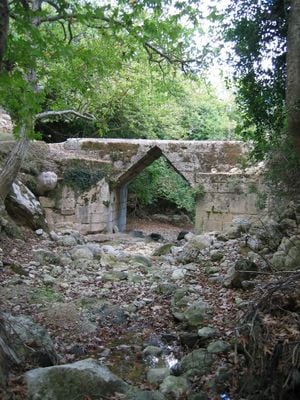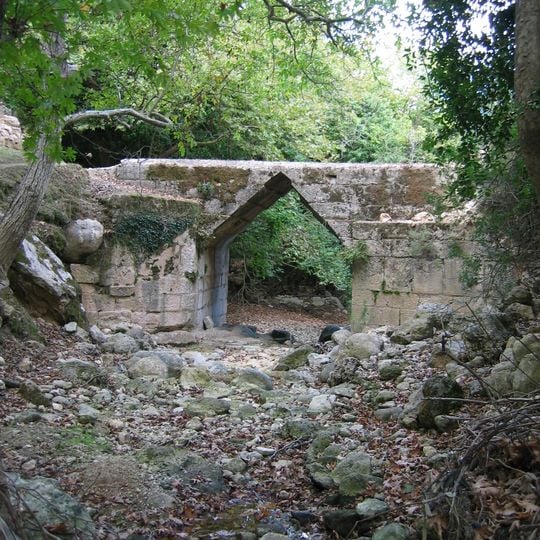
Eleutherna Bridge, Stone footbridge in Eleutherna, Greece.
Eleutherna Bridge is an ancient Greek corbel arch footbridge near the town of Eleutherna in Rethymno Prefecture, Greece. It has a single triangular opening 3.95 m wide and 1.84 m high, cut from unmortared limestone blocks. The bridge is 9.35 m long, 5.1 to 5.2 m wide, and 4 to 4.2 m high.
The bridge was first recorded by the English traveller T.A.B. Spratt, who visited the site in 1853 and published it in his Travels and Researches in Crete. A second ancient bridge with a triangular arch stood a few hundred metres away but was destroyed before 1893. Scholars agree on a pre-Roman date: Nakassis places the surviving bridge in the Hellenistic period, while Galliazzo argues for the late 4th or early 3rd century BC.
This ancient stone crossing demonstrates how people built stable river passages without using mortar to join the limestone blocks. The construction reveals practical knowledge that local builders developed for working with local materials.
The bridge stands near the ancient site of Eleutherna in Rethymno Prefecture, reached by rough paths rather than a formal walkway. The deck is flat and topped by a low parapet wall, and the structure is still in use, so expect uneven stone underfoot and no railings beyond the parapet. Wear sturdy shoes and check footing on the approach.
The triangular opening is a corbel arch: each limestone block oversails the one below until the courses meet, with no mortar between them. The span of 3.95 m is unusually wide for this false-arch technique, and the bridge is still in use today.
The community of curious travelers
AroundUs brings together thousands of curated places, local tips, and hidden gems, enriched daily by 93,380 contributors worldwide.