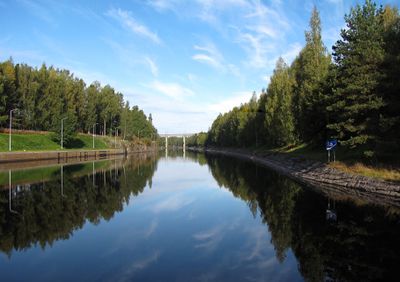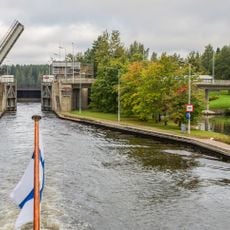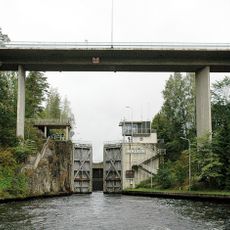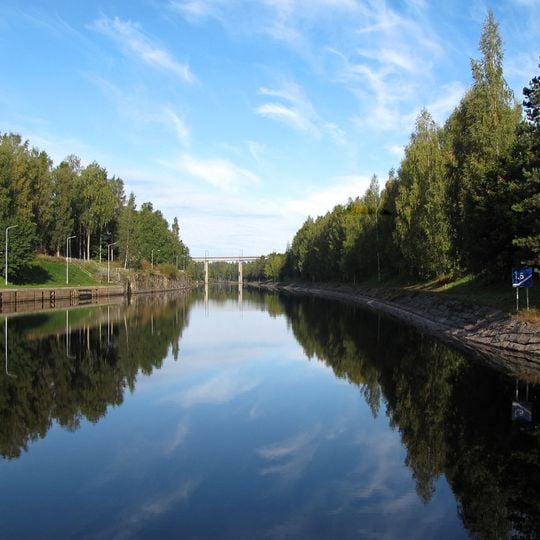
Saimaa Canal, Transportation canal between Lappeenranta, Finland and Vyborg, Russia
The Saimaa Canal connects Lake Saimaa to the Gulf of Finland across 43 kilometers, passing through both Finnish and Russian territory. Eight locks manage a 76-meter elevation change, allowing vessels to move between inland waters and the open sea.
Work began in May 1845 under the Swedish engineer Nils Ericson and was the largest construction project then undertaken in Finland, employing up to 3,000 men at once. The canal opened on 7 September 1856 with 28 locks and 58 kilometres of waterway. It cost three million roubles, more than the state's annual budget, but repaid its cost in under 25 years.
The canal's name appears as Saimaan kanava in Finnish, Saima kanal in Swedish and Сайменский канал in Russian. Its opening in 1856 made it a tourist attraction, and the Saimaa Canal Museum in Lappeenranta displays its history. The Mälkiä lock houses a remote control centre that operates every lock and bridge along the waterway.
Navigation runs around the clock, but the season is fixed each year by the two states according to ice conditions; in 2014 the canal was closed from 27 January to 5 April for repairs. The canal is 50 to 60 metres wide and at most six metres deep, with eight locks whose drops range from 5.5 to 12.4 metres. Seven opening bridges and six fixed bridges cross it, and all locks and bridges are operated from the remote control centre at the Mälkiä lock.
The 19.6-kilometre Russian stretch of the canal is leased to Finland until 2063; the annual rent has a fixed part of 1.22 million euros plus 0.18 euros per gross tonnage unit above 1.5 million. Finland operates the locks and bridges, while Russia maintains the approach fairway.
The community of curious travelers
AroundUs brings together thousands of curated places, local tips, and hidden gems, enriched daily by 94,661 contributors worldwide.