Esztergom Castle, Medieval castle ruins in Esztergom, Hungary
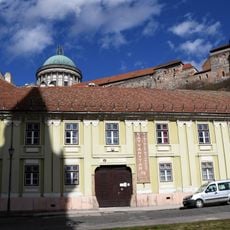
Esztergom Castle stands on a rocky plateau above the Danube in Esztergom, its stone and brick buildings grouped around a grassy courtyard. A long stone building with a pitched red roof has a row of arched openings at its base, and a central gateway building carries a large arched passage. A tall stone wall with small windows and an upper gallery stands to its right, while a large round tower with a conical red roof rises behind.
Géza, Grand Prince of the Hungarians, began building a palace on Castle Hill in the last third of the 10th century; his son Stephen I was crowned in the church standing here and made the castle one of the kingdom's main seats. The residential buildings visible today were raised on the southern rock by King Béla III with foreign master builders, centred on a polygonal tower and a castle chapel. During the Mongol invasion of 1241–1242 the stone castle held out under Count Simon, though the royal town below was sacked; Béla IV moved the royal seat to Buda in 1256 and left the castle to the archbishops.
The castle's name lives on in the Turkish folk song "Estergon Kalesi Türküsü", inspired by the 1595 siege recorded by Ottoman historian İbrahim Peçevi. The southern part of the complex now houses the Castle Theatre, the Hungarian National Museum's Castle Museum and a panopticum. A replica of the fortress was inaugurated in Ankara, Turkey, in 2005.
The site is open to visitors daily with access to restored sections of the former palace and defensive walls. Plan your visit outside the hottest summer months since the ruins offer little shade and climbing the hillside can be tiring.
A copy of the castle was built in Ankara, Turkey, and inaugurated in 2005 as Estergon Kalesi. In 2008 the complex received the European Heritage Label and appears on Hungary's UNESCO Tentative List. The White Tower, completed in 2009, shelters a fresco attributed to Sandro Botticelli found in the castle museum in 2007.
The community of curious travelers
AroundUs brings together thousands of curated places, local tips, and hidden gems, enriched daily by 94,082 contributors worldwide.