Széchenyi Mansion, Baroque memorial museum in Nagycenk, Hungary.
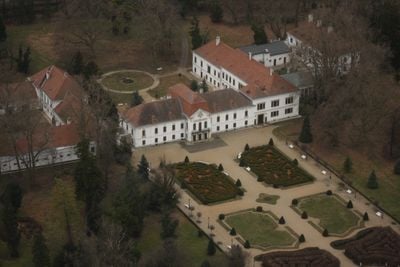
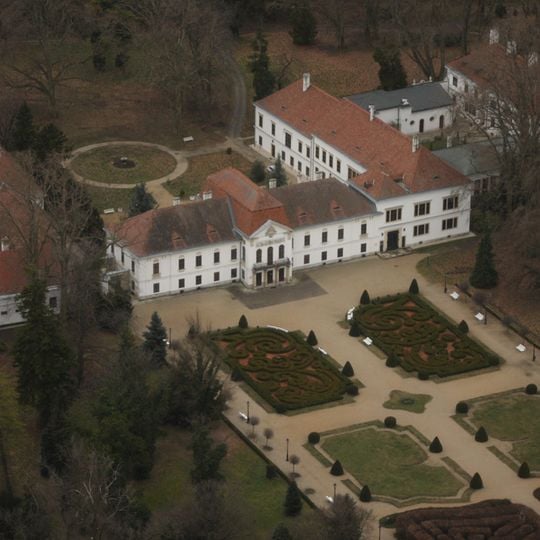
Széchenyi Mansion is a Baroque palace with pale walls, a red-tiled roof and a projecting central section topped by a curved pediment and a small tower. A long lower wing with a matching red roof extends to the left, ending in a rounded corner. The main facade carries the combined Széchenyi-Barkóczy coat of arms in the pediment and a relief frieze with the year 1750.
The building was constructed around 1750 and later received significant renovations between 1834 and 1840 by multiple architects. These expansions reflected the family's growing importance and their influence on Hungarian development during the 19th century.
The Széchenyi family shaped Hungarian history, and the mansion shows how the nobility lived and thought across generations. Personal belongings and furnishings from different periods reveal the daily life and concerns of this influential family.
The mansion stands in Nagycenk, with the main gate from 1741–1750 by Franz Anton Pilgram facing the formal parterre garden of clipped hedges and gravel paths. After wartime destruction, the interior retains essentially only the classicist staircase, so the visit centres on the exterior and the museum rooms. The complex was rebuilt in 1969–1973; part now serves as a museum, the rest as a castle hotel and restaurant.
The main gate from 1741–1750 is attributed to Franz Anton Pilgram, whose original plans were never fully built. In the central pediment a large combined Széchenyi–Barkóczy coat of arms survives, with a relief frieze along the cornice bearing the year 1750. Much of the original interior was lost at the end of World War II; mainly the neoclassical staircase remains.
The community of curious travelers
AroundUs brings together thousands of curated places, local tips, and hidden gems, enriched daily by 94,322 contributors worldwide.