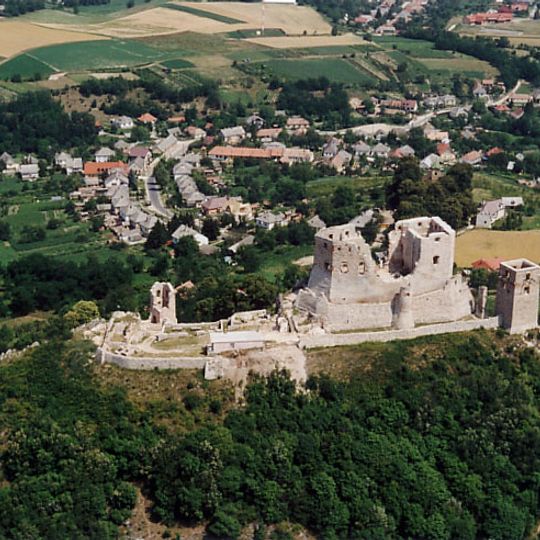
Castle of Csesznek, Medieval fortress ruins in Csesznek, Hungary
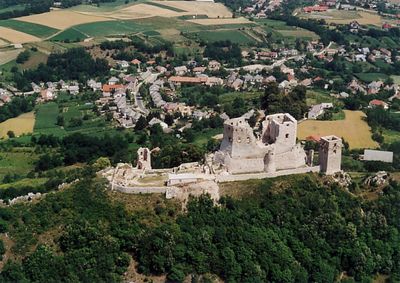
The Castle of Csesznek stands on a wooded hilltop above the village of Csesznek in the Bakony, between Győr and Zirc. Its ruins are of pale grey and tan stone: a tall rectangular tower with small openings and a doorway, joined by a lower wall to a second, blockier tower of rough light stone. To the left a broken rounded wall section runs along a grassy ridge, and a long low retaining wall follows the slope below, with an open ground area behind it. The 15th-century upper castle had a rectangular plan joined to a pentagon around an inner courtyard, and its north-western gate was probably protected by a drawbridge; the Garai–Cillei coat of arms on its lintel stone survives.
Baron Jakab Cseszneky built the original fortress in 1263 as part of Hungary's defense system following Mongol attacks. The structure was expanded over the centuries and remained a key stronghold for the region.
The castle's name comes from the Cseszneky family, who built it in the 13th century. In summer the village of Csesznek hosts cultural programmes, including concerts and theatrical performances, some held in the castle grounds. Visitors can also look for the carved stone fragments kept in the Hungarian National Museum, which hint at the wealth of the Garai provost who rebuilt the upper castle.
The site sits on a rocky hilltop surrounded by open meadows and can be reached by several paths climbing the limestone slope. Sturdy shoes are wise, as the ground is uneven and some routes become steep.
The grounds feature Hungary's first via ferrata climbing routes, where visitors can ascend the castle slopes using secured metal cables and anchors. This climbing opportunity is unusual for medieval ruins in the area.
The community of curious travelers
AroundUs brings together thousands of curated places, local tips, and hidden gems, enriched daily by 93,849 contributors worldwide.