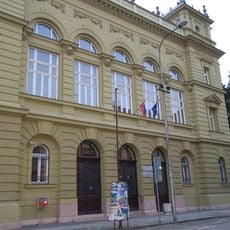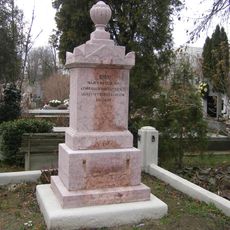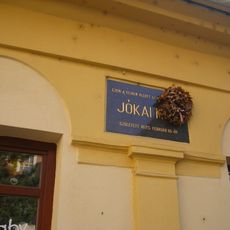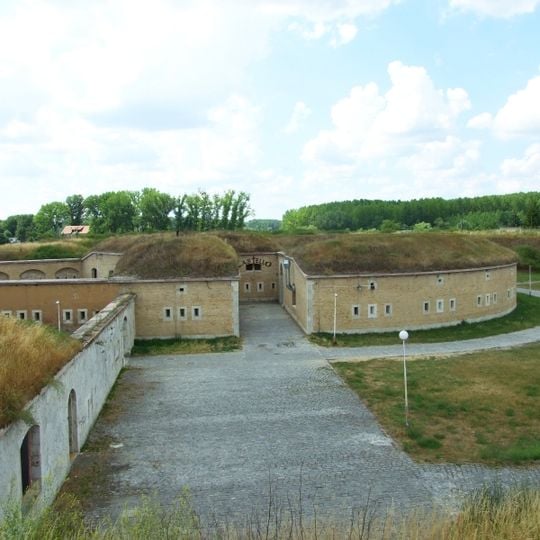
Fortifications of Komárno, Fortification system on both banks of the Danube, Komárom, Hungary and Komárno, Slovakia.
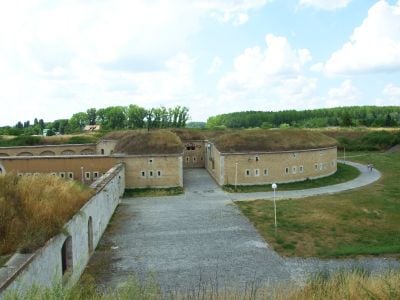
The Fortifications of Komárno comprise the Old Fortress and the New Fortress at the confluence of the Váh and Danube, plus the Palatinus and Váh lines and bridge-heads on the left bank. The New Fortress, finished in 1673, is a pentagonal work built on Italian and French principles. Across the Danube at Komárom stand the Csillag, Monostor and Igmánd forts.
Construction began in 1546 under Italian architect Pietro Ferrabosco to protect against Ottoman expansion into Habsburg lands. The structure was later enlarged and modernized repeatedly, especially in the 18th century, to keep pace with advancing artillery technology.
The Hungarian name Komárom derives from the Slavic Komárno, and the fortress system appears on Slovakia's list of national cultural monuments. The Old Fortress houses the Roman Lapidarium museum, while Fort Igmánd holds the Brigetio Lapidarium and Fort Monostor its own fort museum. The left-bank defences received a Europa Nostra award in 1994 for their restoration.
The two sides of the complex are politically separate and require separate visits, but both have marked paths and viewing points for orientation. Wear comfortable shoes as you'll walk over uneven ground and climb stairs, especially in the older bastion sections.
The fort system was built to shelter a 200,000-strong army, and after 1945 the Monostor fort on the Hungarian bank served as a Soviet ammunition depot while the Slovak forts housed Soviet garrisons. Museums opened in the forts after the political changes of 1989–1991.
The community of curious travelers
AroundUs brings together thousands of curated places, local tips, and hidden gems, enriched daily by 93,660 contributors worldwide.