Sárvár Castle, Renaissance castle in Sárvár, Hungary
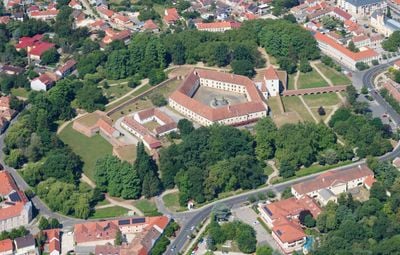
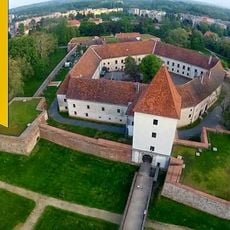
Sárvár Castle is a fortified château near the western bank of the Rába, built around a rectangular courtyard enclosed by pale-plastered wings of two lower storeys and a taller third level under continuous reddish-brown tiled roofs. A tall white square tower with a steep pyramidal roof and a round-arched stone gateway stands at one corner, and a red-brick arched bridge leads to it. The courtyard holds a small round fountain, and a crenellated brick-red wall runs out across the grass.
King Sigismund transferred the fortress to an archbishop in 1390, giving it a strong connection to the Church and to learning. In the 16th and 17th centuries the Nádasdy family took ownership and expanded the castle into a major residence in the region.
The Nádasdy Ferenc Museum fills 1,300 m² of the castle, including an exhibition on printing and book publishing on the Nádasdy estates and Carta Hungarica, a show on map history. A separate hall displays hussars from 1526 to 1945, described as Europe's only hussar exhibition. The courtyard is ringed by a Renaissance arcade, while the ceremonial hall and neighbouring salons were built in Baroque taste.
Visiting all floors takes a few hours, so it is worth setting aside enough time and wearing comfortable shoes for the stairs and uneven surfaces. Guided tours in several languages are available on site and provide useful context for what you see in each room.
The ceiling frescoes and seccos of the great hall were painted in 1653 by Hans Rudolf Miller, a Viennese artist, not by local witnesses. Most of the monumental battle series depicts clashes fought against the Ottomans by Ferenc Nádasdy II, called the "Black Bey" by the Turks.
The community of curious travelers
AroundUs brings together thousands of curated places, local tips, and hidden gems, enriched daily by 93,830 contributors worldwide.