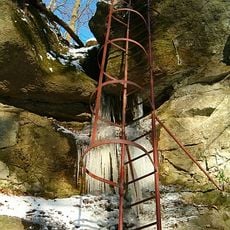
Weislich Cave, Artificial cave in Pomáz, Hungary.
Weislich Cave is a man-made cavity cut into the white andesite tuff of the Nagy-szikla rock in the Holdvilág-árok valley at Pomáz. Its lower entrance is a triangular opening about 3 m high and 2 m wide, leading to a 4.1 m deep shaft with three steps, then a corridor into the 11.1 m Main Corridor. A near-vertical 14.9 m chimney rises to the hidden upper entrance, and eight hive-like niches are carved into the southeast face.
The cavity was cut entirely with tools from white andesite tuff, at roughly the same time and by the same technique as the nearby Y-ágú Cave and Vízesés-alatti Cave, according to Eszterhás István. Its ground plan differs from those two, so its function may have been different. It was later fitted with iron doors and iron climbing holds, and is now in poor, littered condition.
The name comes from a legend that a robber named Weislich, or Veiszlics, hid here and preyed only on the wealthy. Older literature lists the hollow under other names, among them Holdvilág-árok barlangja and Remete-barlang. A Greek-letter Christ monogram is carved into the rock tower north of the shaft opening.
Visiting requires specialized equipment and expert guidance to safely navigate the underground passages. The narrow nature of some tunnels and damp conditions make proper preparation essential.
The upper entrance is deliberately hidden: it cannot be seen from the base of the rock group and is only noticeable from close up among the towers, which may point to defensive or escape use. North of the shaft opening, a Greek-letter Christ monogram is carved into a taller rock tower.
The community of curious travelers
AroundUs brings together thousands of curated places, local tips, and hidden gems, enriched daily by 92,651 contributors worldwide.