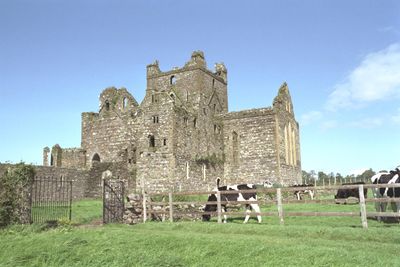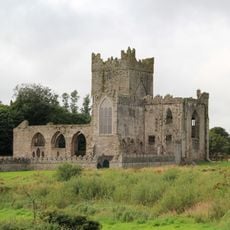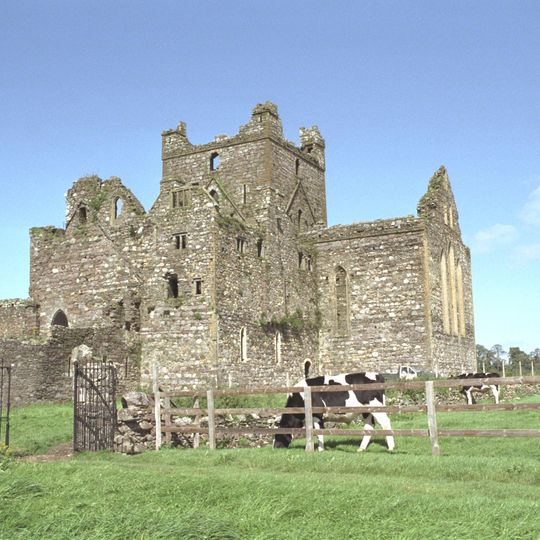
Dunbrody Abbey, Cistercian monastery in County Wexford, Ireland.
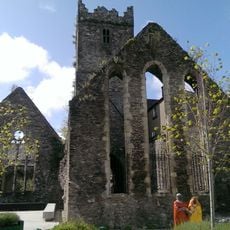
Dunbrody Abbey is a ruined Cistercian monastery in County Wexford, its cross-shaped church measuring 59 m, one of the longest in Ireland. The nave is separated from the aisles by a five-bay arcade; the north aisle wall survives thanks to four large buttresses. The 15th-century bell tower was built on new piers beside the old transept arches, and the south arcade and aisle wall collapsed in a storm on Christmas Eve 1852.
Richard de Clare, known as Strongbow, asked his uncle Herve de Montmorency to found the abbey, and Montmorency donated the land. Buildwas Abbey in England refused the gift after a lay brother's unfavourable report, so the site passed to St. Mary's Abbey, Dublin, whose monks arrived in 1182. Dunbrody was dissolved in 1536 under Henry VIII; the last abbot, Alexander Devereux, later became Bishop of Ferns.
The monastery follows traditional Cistercian design with a nave, side aisles, and transepts that show how medieval monks organized their sacred spaces. This layout shaped the daily rhythm of religious life within these walls.
The ruins can be explored on your own, though a visitor center provides information and guidance for those who want it. The grounds are fairly easy to walk through, with open pathways between the main structures.
The grounds contain a large maze made from about 1,500 yew trees, one of only two full-size hedge mazes in Ireland. This modern feature contrasts sharply with the medieval ruins and draws visitors who enjoy solving their way through winding paths.
The community of curious travelers
AroundUs brings together thousands of curated places, local tips, and hidden gems, enriched daily by 92,619 contributors worldwide.