Slieve Rushen, Mountain summit on Ireland and United Kingdom border, County Cavan.
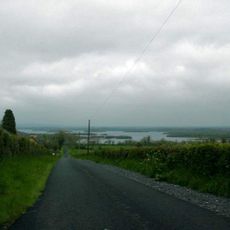
Slieve Rushen is a 404-metre mountain straddling the border between County Cavan in the Republic of Ireland and County Fermanagh in Northern Ireland. It is built of grey limestone capped with sandstone and shales, and its surface is mostly covered with peat, conifer forests and grazing fields. The mountain also holds several caves and swallow-holes, including Pollnagollum and Tory Hole.
Slieve Rushen is named in the Lebor Gabála Érenn (c.1100) as the site of the battle of Raissen, fought by the high-king Túathal Techtmar around 76 AD. The Annals of the Four Masters, Tigernach and Chronicon Scotorum all record that Toirdhealbhach Ua Conchobhair plundered as far as Sliabh-Ruisen and Loch Éirne in 1111. In the 1609 Plantation of Ulster the summit was granted to John Sandford, who sold it to Toby Caulfeild, confirmed by patent of 12 July 1620.
The name Slieve Rushen comes from the Irish Sliabh Ros-in, 'mountain of the little wood'. A Middle Irish text of about 1400 in the Yellow Book of Lecan gives another origin, naming a woman as the source of the name. A traditional Irish jig, the Slieve Russell, is named after the mountain.
The mountain is accessible for walking and hiking, though visitors should expect wet and boggy conditions on the slopes at various times of year. Several caves including Pollnagollum are located nearby and require proper equipment and preparation if you wish to explore them.
A traditional Irish jig called "The Slieve Russell" is named after the mountain. Its name also appears in a poem on the River Shannon by Tadg Óg Ó hUiginn (born 1582), which places the river's source near Slieve Rushen rather than crediting Brian Boru.
The community of curious travelers
AroundUs brings together thousands of curated places, local tips, and hidden gems, enriched daily by 93,898 contributors worldwide.