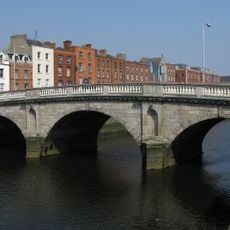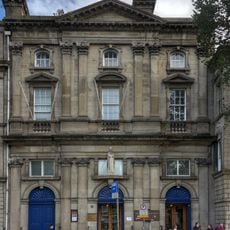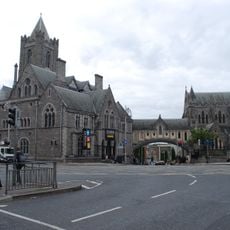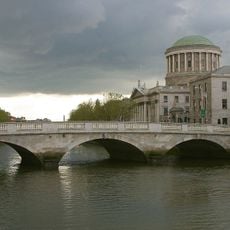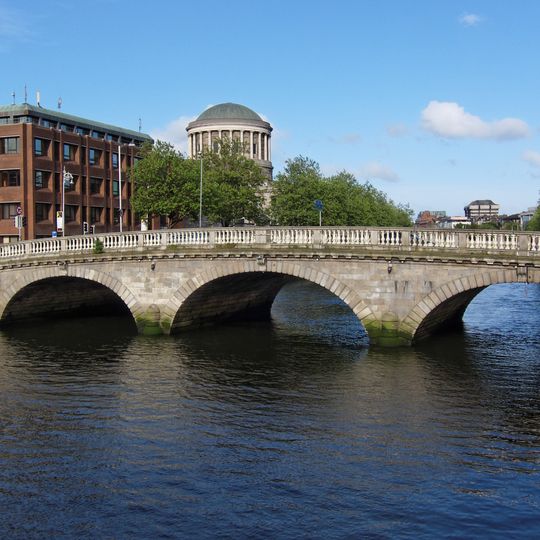
Father Mathew Bridge, Stone bridge across River Liffey in Dublin, Ireland
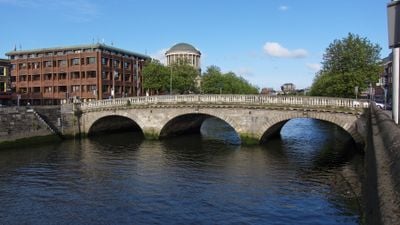
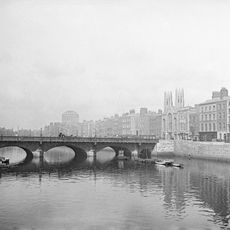
Father Mathew Bridge is a stone crossing of the River Liffey that connects Merchants Quay on the south bank to Church Street on the north. The granite structure has three elliptical arches and wide roadways that accommodate both vehicle and foot traffic.
A wooden bridge stood here by about 1014, rebuilt over centuries and replaced by a Norman bridge sanctioned by King John in the early 13th century. After floods destroyed it, the Dominicans of Ostmantown Friary built a four-arch masonry bridge in 1428 that served for nearly 400 years. George Knowles designed the present three-arch granite bridge, opened in 1818 as Whitworth Bridge; it was renamed Dublin Bridge in the 1920s and Father Mathew Bridge in 1938.
The bridge is named after Father Theobald Mathew, the Capuchin friar from Thomastown, County Tipperary, known as the Apostle of Temperance. The 1938 renaming followed a Dublin tradition of honouring temperance campaigners. Mathew led a mass abstinence movement in the 19th century, and his name is still read daily by pedestrians crossing between Merchants Quay and Church Street.
The bridge offers good accessibility for pedestrians and vehicles with wide, level surfaces on both sides. It serves as a central crossing between Dublin's northern and southern riverside areas and can be used at any time of day.
The medieval Bridge of Dublin carried shops, houses, an inn and St Mary's Chapel on its piers, with towers at each end. In 1312 Mayor Geoffrey de Morton was reprimanded for putting up a house on the bridge without permission; his son-in-law John de Grauntsete finished the towers and built the chapel. Tolls and the chapel were still in use as late as 1762.
The community of curious travelers
AroundUs brings together thousands of curated places, local tips, and hidden gems, enriched daily by 92,781 contributors worldwide.