Four Courts, Neoclassical courthouse in Dublin, Ireland
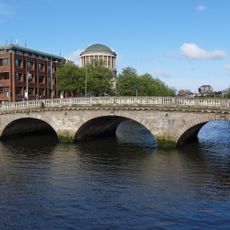
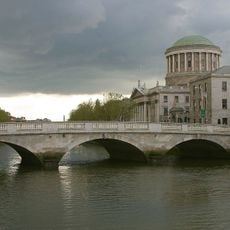
Four Courts is a courthouse in Dublin built of grey granite and Portland limestone, with a tall central dome and a riverfront facade facing the Liffey. The circular hall inside is supported by Corinthian columns and leads to galleries and courtrooms that extend on either side.
Construction began in 1776 to Thomas Cooley's design for the Public Records Office; after his death in 1784 James Gandon took over, and the courts occupied the building from about 1796, with arcades and wings finished in 1802. In April 1922 anti-Treaty IRA forces under Rory O'Connor seized the complex; National Army bombardment from 28 June destroyed the west wing and the Public Record Office, and nearly a thousand years of archives burned. The courts sat in Dublin Castle until a rebuilt Four Courts reopened in 1932.
The name comes from the four superior courts once housed here: Chancery, King's Bench, Exchequer and Common Pleas. The 1877 Judicature Act replaced them with two courts, but the old name stayed. Visitors may see robed barristers crossing the inner hall between hearings.
The courthouse operates on weekdays, so visitors cannot enter all areas and must pass security checks at the entrance. Photography is not allowed inside, and the rotunda is only accessible during opening hours.
The copper-clad dome above the rotunda rises nearly as high as the dome of St. Paul's Cathedral in London. After the explosion, many sandstone cornices and wooden panels were replaced with plaster and modern materials.
The community of curious travelers
AroundUs brings together thousands of curated places, local tips, and hidden gems, enriched daily by 93,469 contributors worldwide.