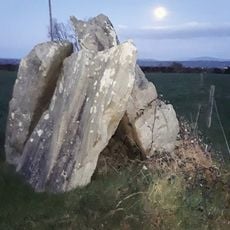
Knockroe Passage Tomb, Neolithic passage tomb in County Kilkenny, Ireland.
Knockroe Passage Tomb is a prehistoric burial site with two stone chambers positioned on a ridge overlooking the Lingaun River valley. The chambers are connected by a passage and surrounded by decorated kerbstones that form the structure.
Knockroe was built between 3000 and 2500 BC, dated by comparison with similar dated monuments. Excavation began in 1990 under Muiris O'Sullivan of University College Dublin's Department of Archaeology and continued over several seasons. The earthen mound and all the chamber roofstones have since been displaced or removed.
The site is known locally as "The Caiseal", a name suggesting a ringfort-like appearance. Carvings occur not only in both chambers but also on the kerbstones, though they are weathered and hard to see without suitable light. The western chamber's carvings resemble those at Fourknocks, Knockmany, Knowth, Loughcrew, Newgrange and Gavrinis in Brittany.
The site is open year-round and sits on elevated ground with open views across the countryside. Visitors should wear sturdy footwear since the terrain is uneven and weather can be changeable.
Only the larger western chamber is aligned so that winter solstice sunset light runs along its passageway; the eastern chamber has no such alignment. The monument holds two separate chambers set about 20 m apart at the ends of an oval cairn edged with kerbstones, an unusual layout for an Irish passage tomb.
The community of curious travelers
AroundUs brings together thousands of curated places, local tips, and hidden gems, enriched daily by 94,349 contributors worldwide.