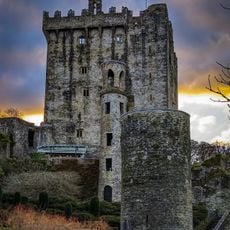
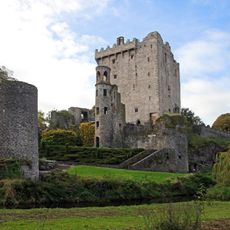
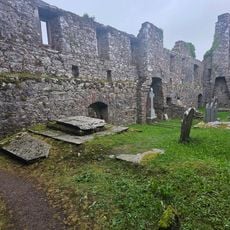
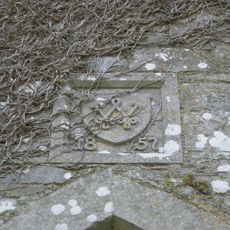
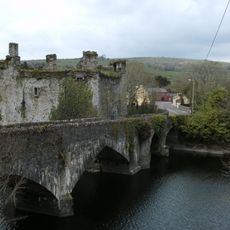
Dripsey Castle, Carrignamuck, Archaeological site and tower house in Carrignamuck, Ireland
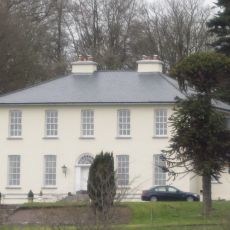
Dripsey Castle is a detached, seven-bay, three-storey country house built c. 1740 in Carrignamuck, 3.3 km north-east of Coachford. It has a central pedimented three-bay breakfront with a Venetian window, a canted bay window on its south side, and a flat-roofed two-storey wing to the north. A farm complex with a matching pedimented breakfront lies to the west.
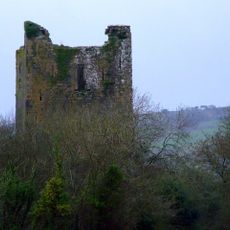
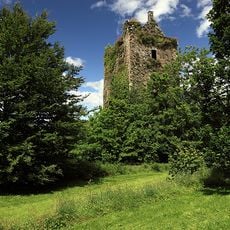
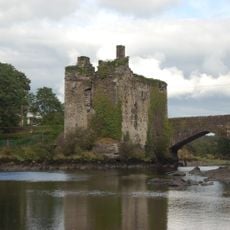
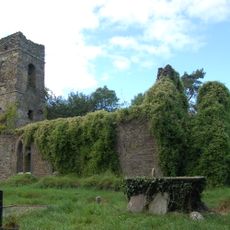
The estate began in the 15th century with Carrignamuck Tower House, commissioned by Cormac McTeige MacCarthy, 9th Lord of Muskerry. The Anglo-Norman Colthurst family took over the estate and built the present country house around 1740 to replace the tower house. The Colthursts held it through the 19th century; the O'Shaughnessy family bought it in 1922, and it sold for €2m in 2015.
The house is named after the townland's earlier tower house, built for Cormac McTeige MacCarthy, 9th Lord of Muskerry, who also commissioned Blarney and Kilcrea castles. The Colthurst family held the estate for generations; a grandson, John Henry, lived here, while another, George, lived at Carhue House. The gardens are sometimes used for local events.
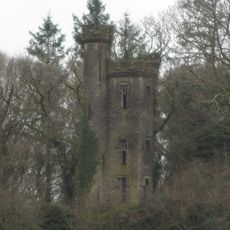
Dripsey Castle is a private residence and cannot be visited; only its gardens are occasionally opened for local events. The gate lodge of c. 1850 and the circular crenellated folly of c. 1840 stand at the entrance gate and can be seen from the road. The house lies 3.3 km north-east of Coachford and 2.5 km north-west of Dripsey village.
The 1944 Irish Tourist Association survey recorded a bookcase in the breakfast room said to be made from timber originating in Carrigadrohid Castle, and a carved marble mantlepiece in the drawing-room. The same survey called Dripsey Castle the principal residence in the parish.
The community of curious travelers
AroundUs brings together thousands of curated places, local tips, and hidden gems, enriched daily by 92,641 contributors worldwide.