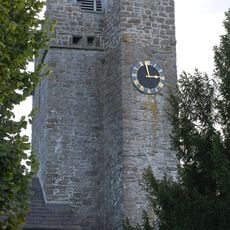
Donaghcumper Church, Medieval church ruins in Celbridge, Ireland
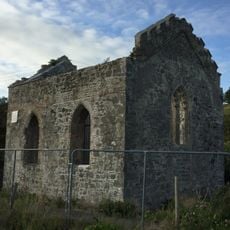
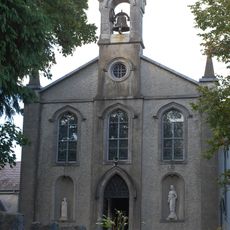
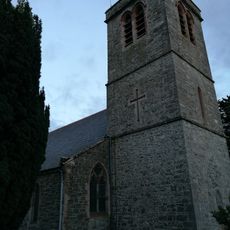
Donaghcumper Church is a medieval church ruin in Celbridge featuring stone construction with a nave, chancel, and a belfry rising from the west gable. The remains show a compact structure typical of the period.
The earliest part of Donaghcumper Church was built around 1150–60, near the time of the Norman invasion of Ireland. In 1202 the de Hereford family gave control of the church to St. Wolstan's Priory, and cut-stone windows were added around 1340. Suppressed at the Reformation, the church passed to John Alan, Lord Chancellor of Ireland, and later became a Church of Ireland church active for about 200 years. A 1770 sketch shows a roof and west tower; by 1897 the site was mapped as ruinous.
The name means "church of the confluence", from Domhnach (Latin dominica, "of the Lord"), a term the 9th-century Book of Armagh links to Ireland's earliest churches. The River Shinkeen joins the Liffey 550 m north of the site. A still-active graveyard surrounds the ruin; its oldest legible grave is Nicholas Walsh, died 1711.
The church stands 800 m east of Celbridge town centre on the R403 Dublin Road, with the River Shinkeen entering the Liffey 550 m to the north. The graveyard around the ruin is still in use, and the earliest legible grave is that of Nicholas Walsh, who died in 1711.
The Alen vault sits at the east end of the chancel, not beneath a side chapel. John Alan, Lord Chancellor of Ireland, was buried here in 1561, followed by his nephew John Alen in 1616 and John's son Sir Thomas Alen, 1st Baronet, in 1627.
The community of curious travelers
AroundUs brings together thousands of curated places, local tips, and hidden gems, enriched daily by 92,878 contributors worldwide.